Somewhere past hour 16 of a fast, many people hit the same wall: a dull headache, a head rush when they stand, a calf cramp in bed. The internet's answer is "electrolytes." Sometimes that's right. Sometimes it's caffeine withdrawal or low blood sugar. Here's what fasting does to sodium, potassium and magnesium, which fasts need extra, the best electrolytes for fasting, and where the safe limits sit.
Quick answer: Fasting lowers insulin, so your kidneys release more sodium and water. For most fasts under 24 hours, salted meals in your eating window usually cover your needs. On longer fasts, put sodium first, then add modest potassium and magnesium within daily limits. Plain, unsweetened electrolytes have no calories and don't break a fast.
Why Fasting Changes Your Electrolytes
Electrolytes are charged minerals that help hold water in your bloodstream and keep nerves and muscles, including your heart, working normally. Fasting shifts them in two ways.
Your kidneys let go of sodium. Insulin tells your kidneys to hold on to sodium. When you stop eating, insulin falls and more sodium leaves in your urine, taking water with it. This "natriuresis of fasting" reverses when you eat again.¹ It's why the scale drops so fast at first: in the first week of a prolonged fast, weight loss averages about 0.9 kg (2 pounds) a day, mainly from lost sodium.²
Your intake drops to almost nothing. More than 70% of the sodium Americans eat comes from packaged and prepared foods.³ Skip meals and most of your minerals go with them. An early metabolic study also documented magnesium depletion during prolonged fasting.⁴
Length matters. In 1,422 people on supervised 4- to 21-day fasts with a daily soup and juice, average blood sodium and potassium dipped but stayed normal, and magnesium held steady. Six developed mild low sodium, corrected with salt.⁵
Do You Need Electrolytes for Every Fast?
No. On 16:8 or one meal a day (OMAD), your eating window usually replaces what you lose. "If you're trying to do 16-8 or OMAD, you really don't have to take any special precautions," says Dr. Chris Rhodes, PhD, Mimio's CEO and scientific founder. That changes past a full day, or when you sweat heavily.
Fast length |
What usually works |
|---|---|
Up to 24 hours |
Water, black coffee or plain tea, and normal salted meals. Lightheaded? Sit down and sip water with a pinch of salt, or eat |
24 to 72 hours |
Sodium first, then modest potassium and magnesium within daily limits |
Longer than 72 hours |
Plan with your clinician; past 5 days, medical supervision only, partly for refeeding risk⁶ |
Our 36 hour fast guide covers the timeline, and the autophagy fasting chart maps each stage. Our 48 hour fast guide covers electrolytes and fluids on a two day fast.
How Much Sodium, Potassium and Magnesium? Amounts and Safe Limits
No dose has been tested specifically for fasting, but daily intakes and limits make a sensible frame: you're replacing some of what food supplies, not loading up.
Mineral |
Daily reference intake (adults) |
Upper limit or caution |
In kitchen terms |
|---|---|---|---|
Sodium |
1,500 mg (Adequate Intake)⁷ |
Cut back if you're above 2,300 mg a day⁷ |
1 teaspoon of salt is about 2,300 mg³ |
Potassium |
3,400 mg for men, 2,600 mg for women (Adequate Intake)⁷ |
No upper limit with healthy kidneys; kidney disease and some medicines change that⁸ |
Salt substitutes hold about 440 to 2,800 mg per teaspoon⁸ |
Magnesium |
310 to 420 mg, depending on age and sex⁹ |
350 mg a day from supplements and medicines⁹ |
Check the label for milligrams of magnesium itself |
Sodium: Usually the One That Matters Most
Sodium is the main mineral lost early in a fast.² Americans average about 3,400 mg a day,³ so a fast can swing you from plenty to very little.
For a fast of a day or longer, a modest amount for healthy adults is ¼ to ½ teaspoon of salt a day, dissolved in water and sipped. That's roughly 575 to 1,150 mg of sodium, well under 2,300 mg.³˒⁷ Heavy sweating raises your needs.³ If you've been told to limit salt, ask your clinician first.
Potassium: Helpful, and the Easiest to Overdo
With healthy kidneys, high potassium intakes haven't been shown to cause high blood potassium (hyperkalemia), so no upper limit has been set.⁸ The risk is concentrated sources: one teaspoon of a potassium chloride salt substitute can exceed a woman's daily Adequate Intake, and very large amounts can outpace even healthy kidneys.⁸ Measure any potassium product and spread it out. Food is easier: a cup of cooked lentils has about 730 mg.⁸
Magnesium: Dose and Timing
- Dose: Keep supplements at or under 350 mg a day; more can cause diarrhea, nausea and cramping.⁹
- Form: Citrate and chloride tend to be absorbed better than magnesium oxide or magnesium sulfate, the compound in Epsom salt.⁹
- Timing: Evening, your first meal or during a fast all work if your stomach handles it. "As long as you can take vitamins and minerals on an empty stomach, and you don't have nausea... go ahead and do it," Rhodes says. Our guide to supplements during a fast covers magnesium powders and drink mixes.
- Expectations: A Cochrane review found magnesium unlikely to meaningfully prevent typical muscle cramps in older adults.¹¹
Signs Your Electrolytes Are Off (and When It's Something Else)
Treat these as prompts for questions, not a diagnosis:
- Low sodium: headache, fatigue, nausea, muscle cramps, confusion.¹⁰
- Low potassium: constipation, fatigue, muscle weakness.⁸
- Low magnesium: loss of appetite, nausea, fatigue, weakness.⁹
- Too much potassium: muscle weakness, tingling, palpitations.⁸
- Too much magnesium: diarrhea, nausea, abdominal cramping.⁹
Not every symptom is electrolytes. Fasting headache is linked especially to low blood sugar and caffeine withdrawal.¹² Lightheadedness on standing is a known fasting complication.² And more plain water isn't always better: low blood sodium is an imbalance of water to sodium.¹⁰ Even supervised fasts see it: across 768 water-only fasts, one 70-year-old man developed severe low sodium on day nine.¹³ Our guide to fasting side effects covers headaches, fatigue and poor sleep in depth.
Stop fasting and get medical help for fainting, a seizure, confusion, chest pain, a racing or irregular heartbeat, or vomiting that stops you keeping fluids down.
Do Electrolytes Break a Fast?
Plain sodium, potassium and magnesium have no calories, so on their own they don't break a fast. For longer fasts, Rhodes's advice is simple: "drink whatever non-caloric beverages you want, but get electrolytes in there."
What breaks a fast is what rides along: sugar, dextrose, fruit juice powder, maltodextrin (a carbohydrate filler) or amino acids such as BCAAs and collagen. Stevia and sucralose add little or no energy, though unflavored is simplest. Bone broth adds protein and calories, which makes it a modified fast. See what to drink while fasting for more options.
Working Out While Fasting: Sweat Changes the Math
Sweat adds to fasting losses. In a controlled study, nine men ate a third of their energy needs for 48 hours, then cycled in 35°C (95°F) heat. Given sodium and potassium chloride, they kept their plasma volume and rode about 67 minutes. With electrolytes restricted too, they lasted about 57 minutes, at higher heart rates.¹⁴
On sweaty workouts during a fast, Rhodes says, "if you're taking the electrolytes, it doesn't really matter." Very long fasts are different: "If someone is doing a two-week fast, I would be like, yeah, don't do a ton of strenuous exercise." On any fast, stop if you feel faint. For training tips, see our guide to fasted cardio.
Snake Juice: What It Is and Whether It's Safe
Snake juice is a homemade electrolyte drink popularized by Cole Robinson, a self-described fasting coach whose Snake Diet centers on long fasts. Recipes vary. A widely shared version mixes 2 liters of water with 1 teaspoon of potassium chloride (a "no salt" salt substitute), ½ teaspoon of pink Himalayan salt, 1 teaspoon of baking soda and ½ teaspoon of food-grade Epsom salt, sipped through the day.
Ingredient |
What it adds |
The catch |
|---|---|---|
Potassium chloride, 1 teaspoon |
Potassium |
Up to about 2,800 mg, more than a woman's daily Adequate Intake in one jug⁷˒⁸ |
Pink Himalayan salt, ½ teaspoon |
Sodium, up to about 1,150 mg, depending on grain size |
Its trace minerals are too small to matter¹⁵ |
Baking soda, 1 teaspoon |
More sodium, as sodium bicarbonate |
Pushes total sodium higher |
Epsom salt, ½ teaspoon |
Magnesium, as magnesium sulfate |
Less well absorbed, and can cause diarrhea⁹ |
The idea is reasonable; the execution is aggressive. Potassium is the main concern, especially with kidney disease, an ACE inhibitor, an ARB or a potassium-sparing diuretic.⁸ Diarrhea from the Epsom salt also drains potassium.⁸˒⁹ The gentler mix below does the same job at sensible amounts.
Best Electrolytes for Fasting: Homemade vs. Packets
A Gentler Homemade Mix
For 1 liter of water, sipped over several hours:
- ¼ teaspoon of salt, about 575 mg of sodium.³ Table salt works as well as pink salt.¹⁵
- Optional, only with healthy kidneys and no potassium-raising medicines: up to ⅛ teaspoon of potassium chloride salt substitute, at most about 350 mg of potassium.⁸
- Magnesium separately, keeping supplements at or under 350 mg a day.⁹
On a full fasting day, some people drink two.
How to Pick the Best Electrolytes for Fasting
- Milligrams per serving of sodium, potassium and magnesium, not just the word "electrolytes."
- A daily total that fits: under 2,300 mg of sodium and no more than 350 mg of supplemental magnesium, counting homemade mixes.
- No sugar, dextrose, maltodextrin or amino acids, and zero calories if you fast strictly.
- Third-party testing, so the label matches what's inside.
For product picks, see our best intermittent fasting supplements roundup and fasting supplements guide.
Who Should Be Careful With Electrolytes While Fasting
Check with your clinician first if any of these apply:
- Kidney disease: even potassium intakes below the Adequate Intake can cause hyperkalemia.⁸
- Blood pressure or heart medicines: ACE inhibitors, ARBs and potassium-sparing diuretics can raise potassium; thiazide diuretics can lower it.⁸
- High blood pressure or heart failure: follow any sodium or fluid limit from your care team. Heart failure and diuretics can themselves cause low blood sodium.¹⁰
- Diabetes medicines: insulin raises the risk of low blood sugar during a fast, and SGLT-2 inhibitors increase urination, adding to dehydration risk.¹⁶
- Fasts longer than five days: refeeding can drop phosphate, potassium and magnesium.⁶
- Pregnancy, breastfeeding, being under 18 or a history of eating disorders: fast only with medical guidance.
Where Mimio Fits in a Fasting Routine
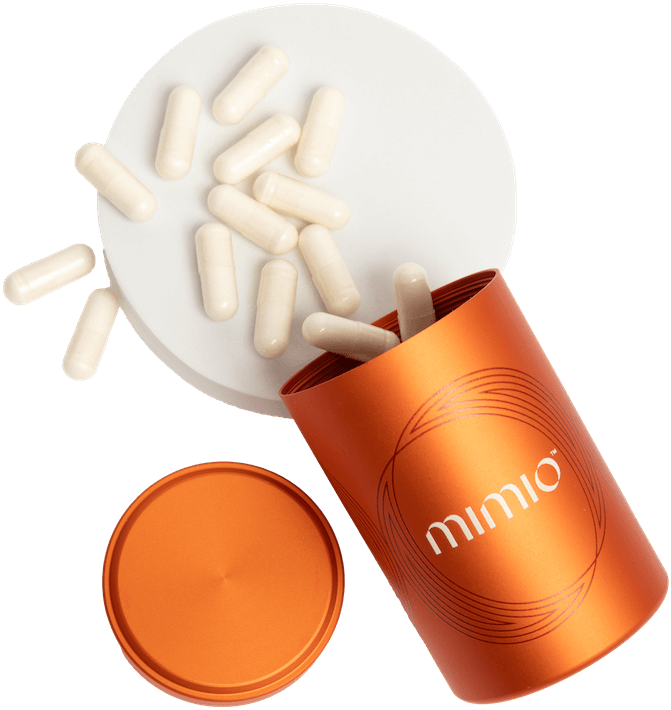
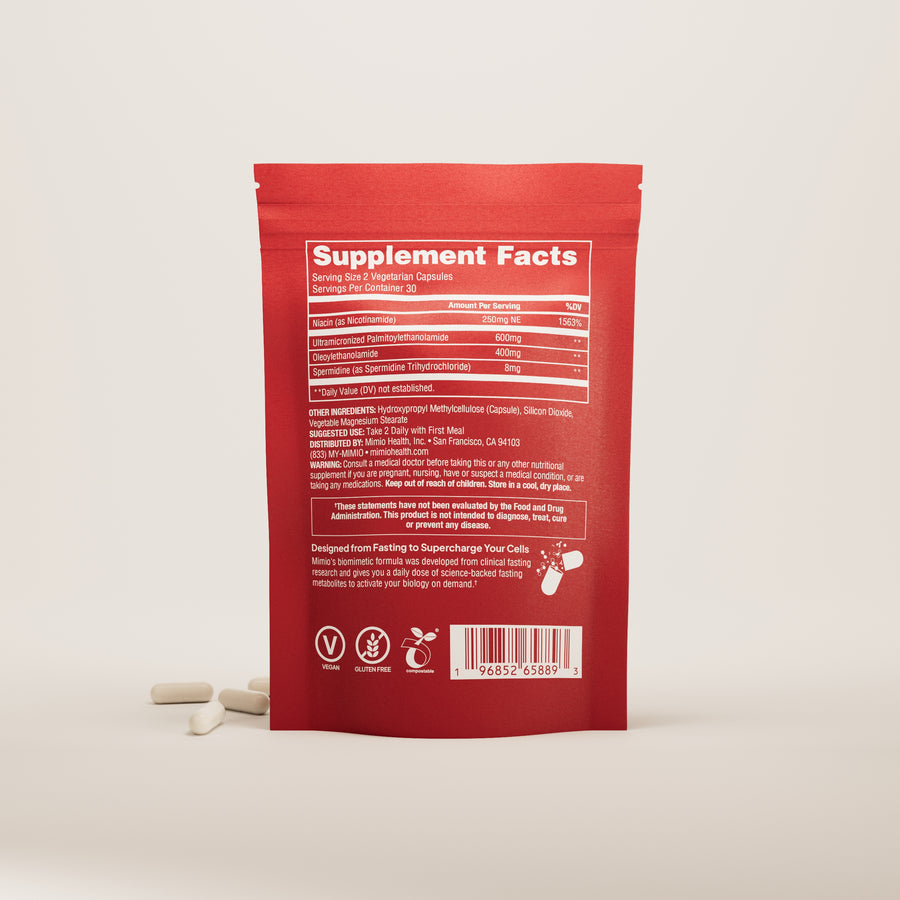
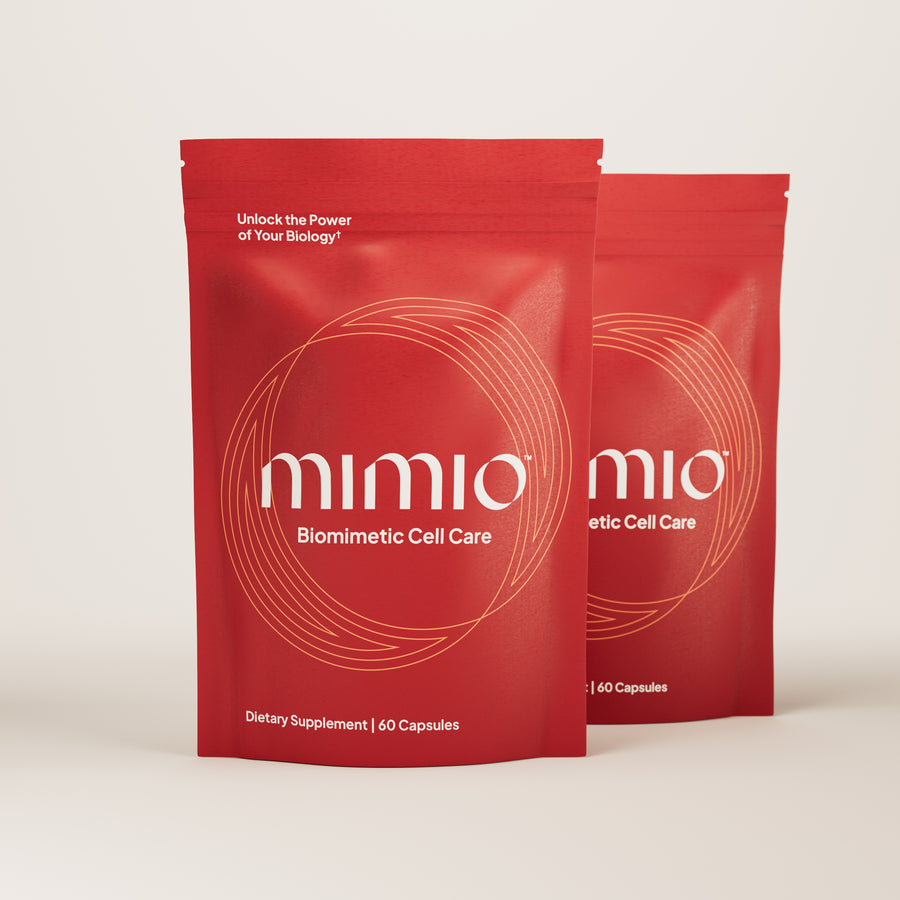
Mimio Biomimetic Cell Care isn't an electrolyte product. It's a daily supplement with spermidine, nicotinamide, PEA and OEA. In the 36 hour fasting study behind Mimio, Dr. Rhodes and colleagues at UC Davis found that blood levels of spermidine, PEA, OEA and a nicotinamide metabolite rose during the fast.¹⁷ Mimio's formula grew out of that research.
The label directs two capsules with your first meal, so Mimio belongs in your eating window, while salt and water carry the fasting hours. It isn't a substitute for electrolytes, water or food, and it doesn't make a long fast safer.
Questions People Ask About Electrolytes and Fasting
What electrolytes should I take while fasting?
Sodium first, then modest potassium and magnesium, mainly on fasts of a day or longer. Under 24 hours, salted meals in your eating window usually cover it. Electrolytes make a sensible fast more comfortable; they can't make an unwise one safe.
Can you have salt while fasting?
Yes. Salt has no calories, so it doesn't break a fast, and on fasts longer than a day it's often the most useful addition. Keep daily sodium under 2,300 mg unless your clinician has set a lower limit.⁷
Will 20 calories of electrolytes break a fast?
Technically, yes: any calories end a strict fast. Whether that matters depends on your goal. For the cleanest fast, choose a zero-calorie product. Our guide to how many calories break a fast goes deeper.
How do I make my own electrolytes for fasting?
Dissolve ¼ teaspoon of salt in 1 liter of water and sip it over several hours. Add magnesium separately, and potassium chloride only in small amounts if your kidneys and medicines allow it.
Can electrolytes help with a stuffy nose?
Not by drinking them. Saline nasal rinses are different: a Cochrane review found they may ease cold symptoms, though the trials were small and low quality.¹⁸
Can you drink electrolytes while fasting for blood work?
Usually not. Fasting for blood work generally means only water, often for 8 to 12 hours, and the basic metabolic panel measures electrolytes directly.¹⁹ Save them for after the draw unless your clinician says otherwise.
This article is for general education and doesn't replace individualized medical advice. Talk with your clinician before fasting or using electrolyte products.
These statements have not been evaluated by the Food and Drug Administration. This product is not intended to diagnose, treat, cure, or prevent any disease.
References
- DeFronzo RA. The effect of insulin on renal sodium metabolism. A review with clinical implications. Diabetologia. 1981;21(3):165-171. doi:10.1007/BF00252649.
- Kerndt PR, Naughton JL, Driscoll CE, et al. Fasting: the history, pathophysiology and complications. West J Med. 1982;137(5):379-399. PMID: 6758355.
- US Food and Drug Administration. Sodium in your diet: use the Nutrition Facts label and reduce your intake. Updated March 5, 2024. Consumer guidance.
- Drenick EJ, Hunt IF, Swendseid ME. Magnesium depletion during prolonged fasting of obese males. J Clin Endocrinol Metab. 1969;29(10):1341-1348. doi:10.1210/jcem-29-10-1341.
- Wilhelmi de Toledo F, Grundler F, Bergouignan A, et al. Safety, health improvement and well-being during a 4 to 21-day fasting period in an observational study including 1422 subjects. PLoS One. 2019;14(1):e0209353. doi:10.1371/journal.pone.0209353.
- Mehanna HM, Moledina J, Travis J. Refeeding syndrome: what it is, and how to prevent and treat it. BMJ. 2008;336(7659):1495-1498. doi:10.1136/bmj.a301.
- National Academies of Sciences, Engineering, and Medicine. Dietary Reference Intakes for Sodium and Potassium. Washington, DC: The National Academies Press; 2019. doi:10.17226/25353.
- National Institutes of Health, Office of Dietary Supplements. Potassium: fact sheet for health professionals. Updated June 2, 2022. Fact sheet.
- National Institutes of Health, Office of Dietary Supplements. Magnesium: fact sheet for health professionals. Updated January 6, 2026. Fact sheet.
- MedlinePlus Medical Encyclopedia. Low blood sodium. US National Library of Medicine. Reviewed May 19, 2025. Encyclopedia entry.
- Garrison SR, Korownyk CS, Kolber MR, et al. Magnesium for skeletal muscle cramps. Cochrane Database Syst Rev. 2020;9(9):CD009402. doi:10.1002/14651858.CD009402.pub3.
- Torelli P, Manzoni GC. Fasting headache. Curr Pain Headache Rep. 2010;14(4):284-291. doi:10.1007/s11916-010-0119-5.
- Finnell JS, Saul BC, Goldhamer AC, et al. Is fasting safe? A chart review of adverse events during medically supervised, water-only fasting. BMC Complement Altern Med. 2018;18(1):67. doi:10.1186/s12906-018-2136-6.
- James LJ, Mears SA, Shirreffs SM. Electrolyte supplementation during severe energy restriction increases exercise capacity in the heat. Eur J Appl Physiol. 2015;115(12):2621-2629. doi:10.1007/s00421-015-3254-1.
- Fayet-Moore F, Wibisono C, Carr P, et al. An analysis of the mineral composition of pink salt available in Australia. Foods. 2020;9(10):1490. doi:10.3390/foods9101490.
- National Institute of Diabetes and Digestive and Kidney Diseases. Fasting safely with diabetes. Clinical guidance.
- Rhodes CH, Zhu C, Agus J, et al. Human fasting modulates macrophage function and upregulates multiple bioactive metabolites that extend lifespan in Caenorhabditis elegans: a pilot clinical study. Am J Clin Nutr. 2023;117(2):286-297. doi:10.1016/j.ajcnut.2022.10.015.
- King D, Mitchell B, Williams CP, et al. Saline nasal irrigation for acute upper respiratory tract infections. Cochrane Database Syst Rev. 2015;2015(4):CD006821. doi:10.1002/14651858.CD006821.pub3.
- Cleveland Clinic. Fasting for blood work. Updated December 10, 2024. Health library.