The Complete Guide to Fasting Supplements: What to Take, What to Skip, and When It Matters
Fasting can feel surprisingly simple. You stop eating. You drink water. You ride the wave.
And then day two shows up with a headache, your legs feel like wet sand, and you start bargaining with the pantry.
That is where fasting supplements come in — not as a "hack" to make fasting harder than it needs to be, but as a way to make fasting more sustainable, safer, and more predictable. The right supplements can be the difference between a fast that builds resilience and one that ends with you face-down in a bag of trail mix at 2 PM.
This guide covers the fasting supplements that actually help (and why), what can break a fast depending on your goal, what to take and when for both intermittent fasting and longer fasts, how to read supplement labels so "zero calorie" does not quietly become "oops," and where fasting mimetics like Mimio fit for people who want fasting biology without the deprivation.
First, Define Your Fasting Goal (Because "Breaks a Fast" Depends on It)
Before you pick fasting supplements, decide what you are fasting for. Different goals have different rules, and most arguments about "what breaks a fast" happen because people are optimizing for different outcomes.
Metabolic Fasting (Fat Loss, Ketones, Glucose Control)
You are trying to keep insulin low and encourage fat oxidation. Small amounts of calories might not "ruin" everything, but they can slow progress. This is the most forgiving fasting category — a splash of cream in your coffee probably is not derailing your results, but it is not technically fasting either.
Gut Rest (Digestive Reset, Reduced Intake)
The priority is giving your digestive system a break. Even low-calorie sweeteners or fiber supplements can stimulate digestive activity for some people. If gut rest is your goal, keep the fasting window genuinely quiet of food intake.
Deep Cellular Signals (Autophagy, mTOR Quieting, Cellular Cleanup)
This is where it gets strict. Amino acids and protein-like ingredients can switch on nutrient-sensing pathways (like mTOR) that are tied to growth signaling, not the scarcity signals that drive autophagy and cellular repair. If deep fasting biology is your goal, you need to be more careful about what you consume during your fasting window.
You can absolutely keep it simple. But if you have ever argued online about whether black coffee is "allowed," you already know: goals change the answer.
The Fasting Supplements That Matter Most
If you only remember one thing from this entire guide, remember this: electrolytes are the main character. Everything else is part of the supporting cast.
Electrolyte Supplements for Fasting: Sodium, Potassium, Magnesium
Electrolytes are not trendy. They are not "biohacking." They are basic plumbing for your nervous system, muscles, and hydration — and they become critically important when you fast.
When you fast, insulin drops. When insulin drops, your kidneys excrete more sodium and water. That cascade can set you up for headaches, dizziness, fatigue, muscle cramps, heart palpitations, and that general "I feel like garbage" sensation that makes people quit fasting prematurely.
Here is the thing most people get wrong: they blame fasting itself for feeling terrible, when the real culprit is electrolyte depletion. In a controlled study published in the European Journal of Applied Physiology, sodium and potassium supplementation during severe energy restriction helped preserve exercise capacity and plasma volume compared with restriction alone. Electrolytes are not optional for serious fasters — they are essential.
What to look for in fasting-friendly electrolyte supplements:
Sodium (salt) is usually the most urgent need — a pinch of high-quality salt in water can make a surprising difference. Potassium supports muscle and nerve function and works in concert with sodium for fluid balance. Magnesium helps with cramps, sleep quality, and nervous system regulation, and a significant portion of the population is already deficient before they start fasting.
What to avoid:
Electrolyte mixes that include sugar, dextrose, maltodextrin, honey, or "energy blends" — these will spike insulin and defeat the purpose. Gummy electrolyte versions are basically candy wearing a lab coat. "Zero calorie" mixes loaded with artificial sweeteners can trigger cravings in some people, which undermines adherence even if they do not technically break the fast.
The practical takeaway: If fasting feels awful, fix your electrolytes before you blame willpower. This is the single most impactful fasting supplement category, and it is the cheapest.
Black Coffee and Tea
Not technically supplements, but they come up in every fasting conversation. Plain black coffee and unsweetened tea are generally compatible with all fasting goals. Both contain essentially zero calories and may actually support some fasting mechanisms — caffeine can enhance fat oxidation and mental clarity during a fast.
The trouble begins when coffee becomes "coffee plus butter plus collagen plus a splash of oat milk plus cinnamon sugar vibes." At that point, you are having breakfast. Call it what it is.
Can You Take Supplements While Fasting? A Category-by-Category Breakdown
This is the question that drives most of the confusion. The short answer is yes, you can take many supplements while fasting — but which ones depend on your fasting goal and the supplement formulation.
Water-Soluble Vitamins (B Vitamins, Vitamin C)
These generally do not contain meaningful calories and are commonly tolerated during a fast. They will not break a fast for any goal.
The catch: Some people get nauseous taking vitamins on an empty stomach. If that is you, move them to your eating window. Compliance matters more than perfect timing.
Fat-Soluble Vitamins (A, D, E, K)
These often come in oil-based softgels, which means they contain calories and fat. Are we talking huge calorie loads? No. But if your goal is strict cellular signaling, fat-based delivery systems are not ideal during a fasting window.
More importantly, fat-soluble vitamins are better absorbed with dietary fat anyway. Vitamin D taken with a meal that includes fat is significantly more bioavailable than vitamin D taken on an empty stomach. Save these for your eating window — you get better absorption and cleaner fasting.
Minerals
Magnesium is the most common fasting-friendly mineral supplement and doubles as an electrolyte. Most forms are fine during a fast. Zinc can cause significant nausea when taken without food, move it to your eating window. Iron is notorious for upsetting stomachs when taken fasted and is also better absorbed with vitamin C from food.
Bottom line: Many vitamin and mineral supplements are fine during a fast, but your stomach gets a vote. When in doubt, reserve your mineral supplementation for your eating windows.
Amino Acids, BCAAs, and Protein Powders
These are the biggest "fast-breakers" in the supplement world. Amino acids — especially branched-chain amino acids (leucine, isoleucine, valine) and essential amino acids (EAAs) — directly activate mTOR, the nutrient-sensing pathway that signals "fed state" to your cells. Research published in Nature Communications has demonstrated that leucine specifically regulates autophagy via mTOR-related mechanisms.
If your goal is deep cellular fasting (autophagy, cellular cleanup), amino acids and protein powders should be kept entirely in your eating window. If your goal is metabolic fasting for body composition, you have slightly more flexibility, but they still represent calories and protein signaling.
Creatine
Creatine monohydrate is not a significant calorie source and does not directly activate mTOR signaling the way amino acids do. Many people keep creatine in their daily routine regardless of fasting status. If you are fasting for strict cellular signaling, you might move all extras to your eating window out of an abundance of caution. For metabolic and body composition fasting, creatine is generally fine.
Fiber Supplements
Psyllium husk, inulin, and other fiber supplements are technically low-calorie, but they feed gut bacteria and stimulate digestive activity. If gut rest is your goal, skip them during the fast. For metabolic fasting, they are a gray area.
What Breaks a Fast: The Practical Framework

There is no single definition of what "breaks a fast," so here is the practical version organized by what most people actually care about.
Generally fasting-friendly for all goals: Water, salt and electrolytes without sugar or calories, black coffee, plain tea, and plain mineral supplements without sugar or fat bases.
May interfere depending on your goal: Artificial sweeteners (some people tolerate them fine, others get cravings or gut responses), fiber supplements, MCT oil, collagen, cream, and gummy supplements (almost always contain sugar or sugar alcohols).
Most likely to disrupt deeper fasting signals: Amino acids (especially BCAAs and EAAs), protein powders, anything with leucine, and calorie-containing fat-based supplements. These can activate nutrient-sensing pathways linked to growth signals and reduce autophagy signaling.
If your goal is fat loss and adherence, you can afford to be more flexible. If your goal is deep fasting signaling — autophagy, mTOR quieting, cellular repair — be stricter.
The Label Trap: How to Read Fasting Supplement Labels
A supplement can say "0 calories" and still be a problem for your fasting goals, because FDA labeling rules allow products with fewer than 5 calories per serving to round down to zero.
Scan ingredient lists for sugar (dextrose, maltodextrin, cane sugar, coconut sugar, honey), fats (MCT oil, coconut oil, "liposomal" formulas which are often fat-based delivery systems), amino acids (leucine, isoleucine, valine, EAAs, BCAAs), "natural flavors" combined with sweeteners (not automatically bad, but often a craving trigger), and gummies or chewables (usually contain sugar alcohols or real sugar to make them palatable).
If you want fasting supplements to actually behave like fasting supplements, keep them boring. The flashier the packaging and flavor profile, the more likely something is hiding in the formula.
Fasting Mimetics: Supplements That Activate Fasting Biology
"Fasting mimetics" is a category that means different things depending on who is using the term. In research literature, caloric restriction mimetics (CR mimetics) are compounds that influence pathways associated with fasting and caloric restriction, AMPK activation, mTOR inhibition, sirtuin upregulation, and autophagy induction.
A few commonly discussed compounds include polyphenols like resveratrol (studied for metabolic and cellular signaling effects with mixed human evidence), spermidine (linked to autophagy-related pathways in preclinical and some clinical research), and berberine (discussed for glucose metabolism support, though it can be powerful and interacts with medications). Metformin and rapamycin are prescription medications sometimes discussed in longevity circles, but they carry real risks and should only be considered under direct clinician supervision.
The important reality check: Even recent reviews note that long-term safety and hard-outcome evidence for many individual CR mimetics in healthy people is still limited. The field is promising but early for most standalone compounds.
Where Mimio Fits, and How to Use It With Fasting
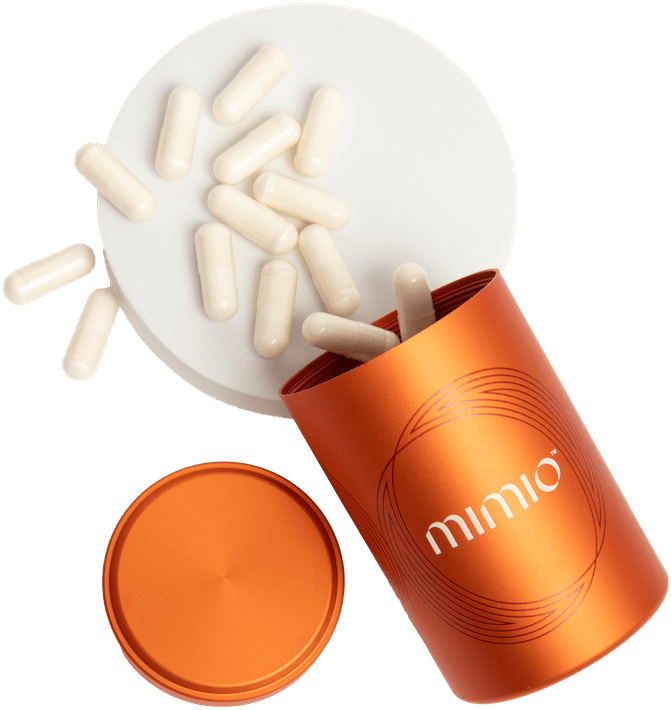
If you fast because you care about cellular health, metabolic resilience, and longevity, not just calorie restriction, then you are already thinking in the direction Mimio Biomimetic Cell Care was built for.
Mimio was designed from human fasting research that identified the specific metabolites your body produces during a 36 hour fast, including spermidine (autophagy activation), nicotinamide (NAD+ and cellular energy support), oleoylethanolamide (OEA) (metabolic signaling and appetite regulation), and palmitoylethanolamide (PEA) (neuroprotection and AMPK activation). Rather than targeting a single fasting pathway in isolation, Mimio recreates the coordinated metabolic response that makes extended fasting so biologically powerful.
This makes Mimio different from both traditional fasting supplements (which support you during a fast) and individual fasting mimetic compounds (which nudge one pathway at a time). Mimio is designed to activate the full fasting biology cascade — whether you take it during a fast to amplify the benefits, on non-fasting days to maintain fasting pathway activation, or as a daily supplement if extended fasting is not realistic for your lifestyle.
How people actually use Mimio with fasting:
Some take it during their eating window to keep fasting windows clean while maintaining daily fasting pathway activation. Some take it during a fast to supercharge the cellular response — the ingredients are the same metabolites your body would produce anyway, AND won’t break your fast. Some take it on non-fasting days as part of a longevity routine to maintain the benefits between fasting periods. And some use it as a daily fasting mimetic because they want the cellular biology of fasting without the deprivation.
If you are experimenting, keep everything else stable for a couple of weeks so you can actually tell what is doing what (we recommend 8 weeks). Changing five variables at once is not optimization — it is chaos with a spreadsheet.
What to Take and When: Timing Guide for Common Fasting Styles
Intermittent Fasting (16:8, 18:6, OMAD)
For most people practicing an intermittent fasting schedule, the supplement approach is straightforward. Take electrolytes early in the fasting window, especially in the morning when sodium depletion from overnight is highest. Use coffee or tea if it helps with appetite control, but do not turn it into a dessert. Move fat-soluble vitamins, zinc, and iron to your eating window for better absorption and fewer stomach issues. Take magnesium in the evening if cramps or sleep quality are concerns. And keep amino acids, protein powders, and calorie-containing supplements in your eating windows.
The most common mistake: Waiting until you feel terrible to start electrolytes. If you tend to get headaches or brain fog during fasting, front-load sodium earlier in the window. Prevention beats recovery every time.
Longer Fasts (24 Hours and Beyond)
Longer fasts raise the stakes on hydration and electrolyte management significantly. For many people, this is where fasting supplements stop being "optional" and start being "this is the reason my fast is tolerable versus miserable."
During a 36 hour fast, electrolyte supplementation should be consistent throughout — not just when symptoms appear. Sodium, potassium, and magnesium all become more critical as the fast extends. Water intake should increase but not excessively (over-hydrating without electrolytes can actually worsen the problem by diluting the electrolytes you have left).
Extra caution for longer fasts: If you are on blood pressure medications, diabetes medications, or have a medical condition, do not treat extended fasting like a casual lifestyle experiment. Medication dosing often assumes regular food intake. Get medical guidance before fasting 24+ hours.
The Most Common Fasting Supplement Stacks
The Minimalist Stack (Best Starting Point)
Electrolytes with a sodium focus, and optional magnesium at night. This covers 80% of what most fasters need and costs almost nothing. Start here before adding complexity.
The "I Get Headaches Every Time" Stack
Electrolytes in the morning and again mid-day, magnesium at night, and consider reducing caffeine if it seems to worsen dehydration. Headaches during fasting are almost always an electrolyte problem, not a food problem.
The Training While Fasting Stack
Electrolytes before training, electrolytes after training, and keep protein and amino acids for the eating window if your goal includes deeper fasting signals. Remember that exercise plus fasting is a stronger physiological stressor than either alone — do not pretend sleep and recovery do not matter.
The Longevity-Focused Stack
Electrolytes during fasting windows, Mimio Biomimetic Cell Care daily to maintain fasting pathway activation, and foundational supplements (omega-3s, creatine, vitamin D if deficient) in the eating window. This is the stack for people who fast because they care about cellular health and aging biology, not just calorie management.
Frequently Asked Questions About Fasting Supplements
What supplements should you take if you are fasting?
The most important fasting supplement category is electrolytes — sodium, potassium, and magnesium. These prevent the headaches, cramps, fatigue, and dizziness that cause most people to abandon fasts prematurely. Beyond electrolytes, water-soluble vitamins (B vitamins, vitamin C) are generally safe during a fast. Fat-soluble vitamins, amino acids, and protein-containing supplements should be moved to your eating window. For people interested in maximizing the cellular benefits of fasting, a fasting mimetic like Mimio can amplify autophagy, NAD+ production, and metabolic signaling, all while not breaking your fast.
Can you take supplements while fasting?
Yes, but it depends on the supplement and your fasting goal. Electrolytes, plain mineral supplements, and water-soluble vitamins are generally fasting-compatible. Fat-soluble vitamins in oil-based softgels contain calories and are better taken with food. Amino acids and protein powders activate nutrient-sensing pathways (mTOR) that can interfere with autophagy signaling. The safest approach: keep calorie-free, fat-free, and amino acid-free supplements in the fasting window and move everything else to the eating window.
Does a 16-hour fast put you in ketosis?
For most people, a 16-hour fast alone is not long enough to achieve significant ketosis. Glycogen stores — your body's stored carbohydrates — typically last 12 to 24+ hours depending on your activity level, diet composition, and metabolic flexibility. Light ketone production may begin toward the end of a 16-hour fast, but meaningful ketosis usually requires 24+ hours of fasting or a very low-carbohydrate diet combined with fasting. That said, 16:8 intermittent fasting still provides metabolic benefits including improved insulin sensitivity and reduced inflammatory markers, even without reaching full ketosis.
What is the best thing to consume while fasting?
Water is the foundation. Beyond that, electrolytes (especially sodium) are the single most impactful thing you can consume during a fast — they prevent the majority of fasting side effects. Black coffee and plain tea are widely considered fasting-compatible and can help with energy, focus, and appetite management. For people who want to activate fasting biology and take their fasts to the next level, a fasting mimetic supplement like Mimio delivers the same metabolites your body produces during an extended fast, supporting autophagy and cellular repair pathways.
How to properly break a 72-hour fast?
Breaking an extended fast requires gradual reintroduction of food. Start with small amounts of easily digestible foods — bone broth, soft-cooked vegetables, or a small portion of protein. Avoid large meals, high-sugar foods, or heavy fats immediately after an extended fast, as your digestive system needs time to restart. Reintroduce complex foods gradually over 2 to 3 meals. Continue electrolyte supplementation during the refeeding period, as your body is still rebalancing fluid and mineral status.
Can electrolytes break a fast?
Electrolytes without sugar, calories, or added amino acids do not break a fast for any practical purpose. They do not trigger insulin, do not activate mTOR, and do not provide caloric energy. In fact, electrolyte supplementation during fasting is one of the most evidence-supported practices for making fasts safer and more sustainable. The only exception is electrolyte products that sneak in sugar, maltodextrin, or other calorie sources — always check the label.
A Sane, Safe Approach to Fasting Supplements
Fasting is a stressor. A useful one, for many people, when applied thoughtfully. But it is still stress, and stacking unnecessary complexity on top of physiological stress is not optimization — it is self-sabotage with good intentions.
The best fasting supplements are the ones that prevent avoidable misery (electrolytes), reduce the chances you quit early (again, electrolytes), help you match your supplement choices to your actual fasting goal, and — if longevity and cellular health are part of your strategy — support the deeper biological pathways that make fasting valuable in the first place.
Start with electrolytes. Keep everything else simple. Use your eating window for the extras. And if you want to pair fasting with a longevity-minded cellular health routine, Mimio Biomimetic Cell Care was designed for exactly that intersection.
Your body notices when you take care of it. It also notices when you do not. Fasting supplements are how you make sure the signal your body receives is "intentional repair," not "accidental deprivation."
References
-
Longo, V. D., & Panda, S. (2016). Fasting, circadian rhythms, and time-restricted feeding in healthy lifespan. Cell Metabolism.
-
de Cabo, R., & Mattson, M. P. (2019). Effects of intermittent fasting on health, aging, and disease. New England Journal of Medicine.
-
Mattson, M. P., et al. (2017). Impact of intermittent fasting on health and disease processes. Ageing Research Reviews.
-
James, L. J., et al. (2015). Electrolyte supplementation during severe energy restriction attenuates reductions in exercise capacity. European Journal of Applied Physiology.
-
Meijer, A. J., & Dubbelhuis, P. F. (2014). Regulation of autophagy by amino acids and mTOR signaling. Amino Acids / Review (PMC).
-
Son, S. M., et al. (2020). Leucine regulates autophagy via mTORC1-related mechanisms. Nature Communications.
-
Deleyto-Seldas, N., & Efeyan, A. (2021). The mTOR–autophagy axis and the control of metabolism. Frontiers in Cell and Developmental Biology.
-
Madeo, F., et al. (2019). Caloric restriction mimetics against age-associated disease. Cell Metabolism.
-
Murillo-Cancho, A. F., et al. (2025). Dietary and pharmacological modulation of aging-related metabolic pathways: molecular insights and clinical evidence. Review (PMC).
-
Fong, C., et al. (2022). Efficacy and safety of nutrient supplements for glycaemic control. Systematic Review (PMC).
-
Mimio Health. Biomimetic Cell Care: formulation research and clinical study data. mimiohealth.com/pages/science.