A 48 hour fast is two full days without calories, often dinner to dinner. Here's what happens hour by hour, which benefits have human evidence, how much of the weight you lose is water, and how to prepare for and break the fast safely.
Quick answer: A 48 hour fast means no calories for two days, often dinner to dinner. By day two your body runs mostly on fat, ketones and newly made glucose, and growth hormone output rises. The scale usually drops a few pounds, mostly water; fat loss tops out around 1 to 1.5 pounds. Skip it if you're pregnant or under 18, and ask your doctor first if you take diabetes medicine.
What Is a 48 Hour Fast?
A 48 hour fast is a two day water fast: no food and no drinks with calories for 48 hours. The simplest schedule runs dinner to dinner, such as 7 p.m. Friday to 7 p.m. Sunday, so you sleep through two of the nights.
Water, sparkling water, black coffee and plain tea are the usual drinks. Milk, sugar, juice, bone broth and protein drinks add calories, which makes it a modified fast. Our guides to what to drink while fasting and how many calories break a fast cover the gray areas, and our overview of types of fasting shows where two days sits among the options.
48 Hour Fast Timeline: What Happens Hour by Hour
Your body moves from your last meal to stored carbohydrate, then mostly to fat and ketones. Nothing flips on at an exact hour: timing shifts with how much glycogen you start with and how active you are.¹
Hours |
What's happening |
Evidence |
|---|---|---|
0 to 12 |
You finish digesting your last meal, then your liver releases glucose from glycogen, its stored carbohydrate¹ |
Well established |
12 to 22 |
Your body also makes new glucose, about 64% of glucose output over the first 22 hours in a classic study.² Ghrelin, a hunger hormone, still rises and falls around usual mealtimes, which may be why hunger comes in waves³ |
Well established; ghrelin data from a study of six people |
12 to 36 |
The metabolic switch: fat and ketones cover more of your energy as liver glycogen runs low.¹ Skipped your usual coffee? Withdrawal headaches typically start 12 to 24 hours in⁴ |
Well established |
22 to 36 |
Newly made glucose rises to about 82% of supply.² Low insulin lets your kidneys release sodium and water, so the scale drops⁵˒⁶ |
Well established |
36 to 48 |
Newly made glucose reaches about 96% of supply over hours 36 to 54, and ketones keep rising.²˒⁶ In nine men, growth hormone output on day two was about five times a fed day's.⁷ Insulin moves less glucose into your tissues⁸ |
Human studies, mostly small |
Your first meal |
Blood sugar rises more than usual and can stay higher for a day⁹ |
One recent trial of 16 adults |
Most older fasting studies enrolled people with obesity, so results may not carry over exactly to lean people.⁶ Treat the hours as a guide, not a schedule.
48 Hour Fast Benefits: What the Evidence Shows
A 48 hour fast reliably shifts your fuel toward fat and ketones and lowers insulin. Most other claimed benefits rest on small human studies or animal research.
Claimed benefit |
What research shows |
Evidence |
|---|---|---|
Fat burning and ketosis |
By day two nearly all glucose is newly made, and ketosis builds²˒⁶ |
Strong |
Lower insulin |
Insulin falls and glucagon rises⁶ |
Strong |
More growth hormone |
About five times a fed day's output on day two, in nine men⁷ |
Small human study |
Shifts in blood metabolites |
44 of about 130 metabolites rose in four people fasting 34 to 58 hours; antioxidant defense may be a main response¹⁰ |
Very small human study |
Autophagy (cell recycling) |
Clear in mice at 24 to 48 hours; unconfirmed in people¹¹˒¹² |
Mostly animal |
Better insulin sensitivity |
It falls in the short term⁸˒⁹ |
Small human studies |
That last row surprises people. Comparing a 12 hour and a 48 hour fast in 25 adults, researchers found insulin-driven glucose uptake fell by roughly 40 to 55% after 48 hours.⁸ In a 2026 trial of 16 healthy young adults, blood sugar rose more after a standard meal at the end of a 48 hour fast than before it, and daily cycling during the fast didn't prevent it.⁹ The authors suggest this differs from disease-related insulin resistance, but a single 48 hour fast isn't an insulin sensitivity treatment.
Autophagy and the 48 Hour Fast: What's Known
In mice, 48 hours without food clearly ramps up autophagy, the cell's recycling system. In people, it's hard to measure, and human data are much more limited.¹²
After 24 and 48 hours without food, mice showed more autophagy, even in brain cells.¹¹ But a mouse isn't a small person: a 48 hour fast costs a mouse about 20% of its body weight, while human volunteers fasting up to four days lost under 2%, and their blood cells showed only limited signs of increased autophagy.¹³ A 2026 review concluded that the most rigorous human measurements are often negative or inconclusive.¹²
So a 2 day fast may raise autophagy in some tissues, but nobody can yet say how much, where or from what hour. Hour by hour autophagy timelines for people are estimates built largely on animal research.
How Much Weight Will You Lose on a 48 Hour Fast?
Expect the scale to drop a few pounds, mostly water and stored carbohydrate. Fat loss is capped by the calories you burn: roughly 1 to 1.5 pounds at most for most adults.
Your body stores glycogen with three to four parts water,¹⁴ and low insulin makes your kidneys release sodium.⁵ In older studies, mostly of people with obesity, weight fell about 0.9 kg (2 pounds) a day early in a fast, mainly from lost sodium.⁶ Nine normal-weight volunteers who went up to four days without food lost under 2% of their body weight.¹³
Fat is simple math:
If you burn about |
Calories burned in 48 hours |
Most fat you could lose |
|---|---|---|
2,000 calories a day |
4,000 |
About 0.44 kg (1 pound) |
2,500 calories a day |
5,000 |
About 0.56 kg (1.2 pounds) |
3,000 calories a day |
6,000 |
About 0.67 kg (1.5 pounds) |
These are ceilings, based on fat's 9 calories per gram.¹⁵ Real fat loss is a little lower, since some energy comes from glycogen and from protein used to make glucose.⁶ Your metabolism doesn't slow in a short fast: in 11 lean adults, resting energy use was about 14% higher on day three than on day one.¹⁶
Much of the water returns when you eat, because insulin tells your kidneys to hold sodium again.⁵ Overeating afterward may be smaller than you'd expect: in one study, lean adults ate about 20% more the day after a 36 hour fast, a small part of the deficit.¹⁷
How to Prepare for a 48 Hour Fast
Work up to it, check the list of who should not fast below, pick two quiet days, and plan your fluids and first meal.
- Build up first. Get comfortable with daily fasting such as 16:8, then a 24 hour fast. Our intermittent fasting schedule guide covers the shorter formats.
- Choose two low-key days. Skip hard training, long drives and big deadlines.
- Eat a normal, balanced last meal. There's no need to feast: a big carbohydrate load stores extra glycogen and water, which mainly makes the scale swing more.¹⁴
- Keep caffeine steady. Keep your usual coffee, black, or taper the week before. Withdrawal symptoms typically start 12 to 24 hours after the last dose and peak between 20 and 51 hours,⁴ right inside a 48 hour fast.
- Stock up. Water, salt, black coffee or plain tea, and a first meal you've already chosen.
Electrolytes and Fluids During a 48 Hour Fast
Sodium matters most. Low insulin makes your kidneys release more sodium and water,⁵ and with no food you take in almost none. Our guide to electrolytes for fasting covers amounts and safe limits.
- Sodium: a modest approach for healthy adults is ¼ to ½ teaspoon of salt across the day, dissolved in water. That's roughly 575 to 1,150 mg of sodium, well under the 2,300 mg daily limit of about 1 teaspoon of salt.¹⁸ If you've been told to limit salt, ask your clinician first.
- Potassium: go easy on potassium salt substitutes and supplements, and skip them if you have kidney disease or take an ACE inhibitor, an ARB or spironolactone, which all raise the risk of high potassium.¹⁹
- Fluids: water, sparkling water, black coffee and plain tea. Some electrolyte mixes contain sugar, so check the label.
Headache or lightheaded on day two? Sit down, sip water with a pinch of salt, and eat if it doesn't settle. Fasting headaches have been linked especially to low blood sugar and caffeine withdrawal.²⁰
How to Break a 48 Hour Fast
Break it with a moderate, balanced meal: some protein, cooked vegetables and a modest portion of whole food carbohydrate, eaten slowly. Save the big or sugary meal for the next day.
After 48 hours without food, blood sugar rises more than usual after eating. In the 2026 trial, the rise after a standard meal was still elevated 24 hours after refeeding and, in an exploratory analysis, larger in women than in men.⁹ So pair carbohydrate with protein and fiber rather than opening with sweets or juice. Our look at fasting and female hormones covers other ways women respond to fasting.
Eggs with sautéed vegetables and toast, Greek yogurt with berries and nuts, or lentil soup with chicken all work. Our guide to what to eat after a fast has more ideas.
Refeeding syndrome, the dangerous fluid and mineral shifts that can follow starvation, is unlikely after 48 hours in a healthy, well-nourished adult. UK NICE criteria flag high risk after more than 10 days of little or no food, or more than 5 days plus another factor, such as a BMI under 18.5, major recent weight loss, alcohol misuse, or medicines including insulin or diuretics.²¹ If any apply to you, get medical advice before fasting at all. Our guide to the 72 hour fast covers refeeding risk in more depth.
How Often Should You Do a 48 Hour Fast?
We found no study that sets a safe or ideal frequency. If a 48 hour fast goes well, keep it occasional, with several days of normal eating in between.
- Recover in between. Blood sugar handling hadn't returned to baseline 24 hours after refeeding,⁹ so don't stack fasts back to back.
- For autophagy: because autophagy is still hard to measure in people, any schedule "for autophagy" is guesswork.¹² More fasts aren't proven to mean more benefit.
- For weight: repeatable formats have the trial data. In a 2025 analysis of 99 randomized trials, alternate day fasting, time-restricted eating and whole day fasting all reduced weight compared with unrestricted eating.²² Our guide to how long intermittent fasting takes to show results sets realistic expectations.
Side Effects and When to Stop
Expect hunger, tiredness and possibly a headache or poor sleep. Stop and eat, or get help, if you feel faint, confused or unwell in a way that doesn't settle.
In a review of 768 medically supervised water-only fasts of two days or longer (the median was seven days), the most common problems included fatigue (48% of fasts), insomnia (34%), nausea (32%), headache (30%) and feeling faint (28%). Three in four reported events were mild.²³ Stand up slowly, since drops in blood pressure on standing are a known fasting complication,⁶ and keep exercise gentle, such as walking.
Stop the fast and get medical help for:
- Fainting, or nearly fainting more than once
- Confusion, slurred speech or unusual drowsiness
- A racing or irregular heartbeat,⁶ or chest pain
- Vomiting that stops you keeping fluids down
Who Should Not Do a 48 Hour Fast
Skip it if you're under 18, pregnant, breastfeeding or have a history of disordered eating. Check with your clinician first if you have diabetes or another chronic condition, or take regular medicines.
- Don't fast if you're under 18, pregnant or breastfeeding, or have a history of an eating disorder or disordered eating.²⁴
- Type 1 diabetes: only with your diabetes team. Fasting raises the risk of dehydration and diabetic ketoacidosis.²⁵
- Diabetes medicines: insulin, sulfonylureas and meglitinides can cause low blood sugar, the main risk of fasting with diabetes, and SGLT2 inhibitors add a dehydration risk. Fast only with a plan from your prescriber.²⁵
- Talk to your clinician first if you're over 65, have heart, kidney or liver disease or low blood pressure, or take blood thinners, diuretics or blood pressure medicines.²⁴
- Gout or kidney stones: gout flares and uric acid stones are known complications of fasting.⁶
- Underweight or recent major weight loss: both raise refeeding risk.²¹
Where Mimio Fits
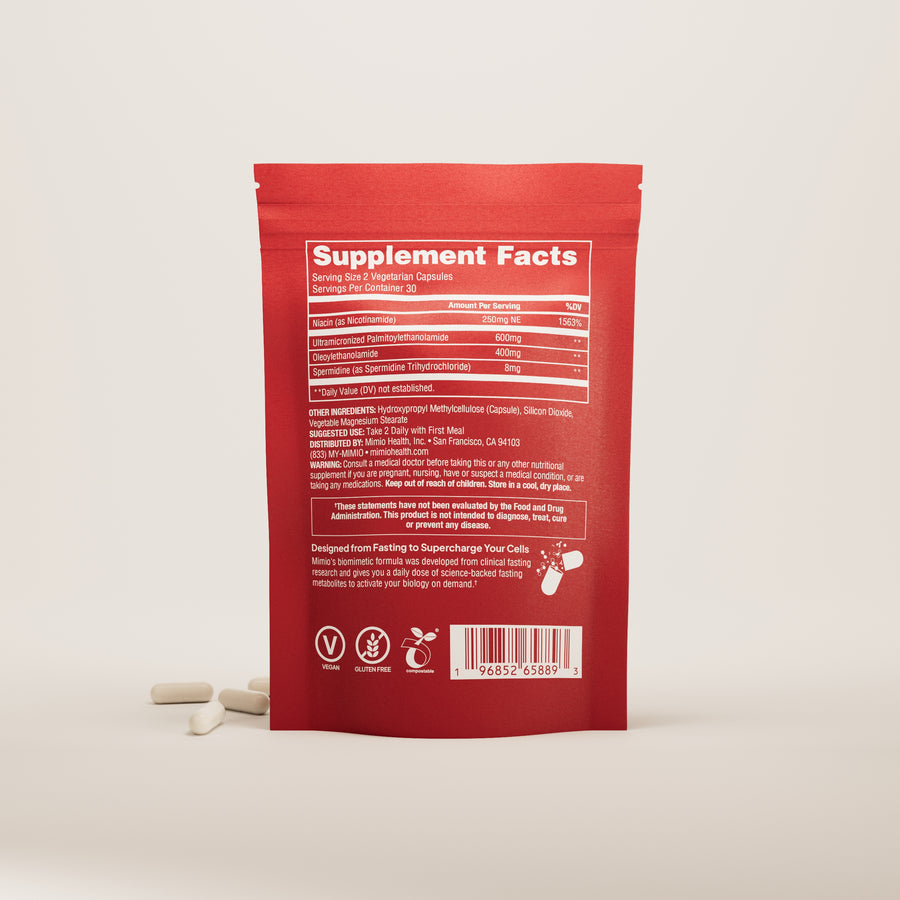
Mimio isn't part of the fast itself, and it doesn't replace one. Mimio Biomimetic Cell Care is a daily supplement with four active ingredients: spermidine, nicotinamide, PEA and OEA. They trace back to the study behind Mimio: Dr. Rhodes's 36 hour fasting study at UC Davis, in which blood levels of spermidine, PEA, OEA and a nicotinamide metabolite rose during the fast.²⁶
The label directs two capsules with your first meal, so during a 48 hour fast it waits until you break the fast, then fits your normal eating days.
The Bottom Line
A 48 hour fast is a real metabolic shift, but the scale drop is mostly water, fat loss tops out around 1 to 1.5 pounds, and human evidence for autophagy is still thin. If you're healthy, build up to it, use salt and fluids, break it with a moderate meal and space repeats well apart.
Questions People Ask About the 48 Hour Fast
Will I lose belly fat if I fast for 2 days?
Only a little. At most about 1 to 1.5 pounds of fat comes off in 48 hours, counting your whole body. Most of the scale drop by day two is water and stored carbohydrate, which return when you eat.⁵˒¹⁴
How many pounds can I lose in 48 hours?
Usually a few pounds on the scale, mostly water. In older studies, mostly of people with obesity, weight fell about 2 pounds a day early in a fast.⁶ Fat loss is capped at about 1 to 1.5 pounds for most adults.
How often should you do a 48 hour fast for autophagy?
There's no evidence-based answer, because autophagy is still hard to measure in people.¹² If that's your reason for fasting, keep fasts occasional, recover fully in between and treat autophagy as a possible bonus, not a measurable target.
Is fasting for 2 days healthy?
It can be for healthy adults, though the evidence is limited. In a review of 768 medically supervised water-only fasts of two days or longer, most reported side effects were mild.²³ It isn't safe for everyone (see the list above), and we found no long-term trial showing that repeated 2 day fasts improve health.
This article is for general education and does not replace individualized medical advice. Talk with your clinician before a 48 hour fast if you take medication, are pregnant or breastfeeding, or have a health condition.
These statements have not been evaluated by the Food and Drug Administration. This product is not intended to diagnose, treat, cure, or prevent any disease.
References
- Anton SD, Moehl K, Donahoo WT, et al. Flipping the metabolic switch: understanding and applying the health benefits of fasting. Obesity (Silver Spring). 2018;26(2):254-268. doi:10.1002/oby.22065.
- Rothman DL, Magnusson I, Katz LD, et al. Quantitation of hepatic glycogenolysis and gluconeogenesis in fasting humans with 13C NMR. Science. 1991;254(5031):573-576. doi:10.1126/science.1948033.
- Natalucci G, Riedl S, Gleiss A, et al. Spontaneous 24-h ghrelin secretion pattern in fasting subjects: maintenance of a meal-related pattern. Eur J Endocrinol. 2005;152(6):845-850. doi:10.1530/eje.1.01919.
- Juliano LM, Griffiths RR. A critical review of caffeine withdrawal: empirical validation of symptoms and signs, incidence, severity, and associated features. Psychopharmacology (Berl). 2004;176(1):1-29. doi:10.1007/s00213-004-2000-x.
- DeFronzo RA. The effect of insulin on renal sodium metabolism. A review with clinical implications. Diabetologia. 1981;21(3):165-171. doi:10.1007/BF00252649.
- Kerndt PR, Naughton JL, Driscoll CE, Loxterkamp DA. Fasting: the history, pathophysiology and complications. West J Med. 1982;137(5):379-399. PMID: 6758355.
- Hartman ML, Veldhuis JD, Johnson ML, et al. Augmented growth hormone (GH) secretory burst frequency and amplitude mediate enhanced GH secretion during a two-day fast in normal men. J Clin Endocrinol Metab. 1992;74(4):757-765. doi:10.1210/jcem.74.4.1548337.
- Bergman BC, Cornier MA, Horton TJ, Bessesen DH. Effects of fasting on insulin action and glucose kinetics in lean and obese men and women. Am J Physiol Endocrinol Metab. 2007;293(4):E1103-E1111. doi:10.1152/ajpendo.00613.2006.
- Bouck T, Marcotte-Chénard A, Barg D, et al. Fasting-induced glucose intolerance is not impacted by the addition of daily exercise: a randomized crossover study. J Physiol. 2026;604(15):6391-6404. doi:10.1113/JP291000.
- Teruya T, Chaleckis R, Takada J, et al. Diverse metabolic reactions activated during 58-hr fasting are revealed by non-targeted metabolomic analysis of human blood. Sci Rep. 2019;9(1):854. doi:10.1038/s41598-018-36674-9.
- Alirezaei M, Kemball CC, Flynn CT, et al. Short-term fasting induces profound neuronal autophagy. Autophagy. 2010;6(6):702-710. doi:10.4161/auto.6.6.12376.
- Singh S, Sargeant TJ. Increasing autophagy with fasting and diet: separating fact from fiction. Biochem Soc Trans. 2026;54(10):1497-1511. doi:10.1042/BST20260632.
- Pietrocola F, Demont Y, Castoldi F, et al. Metabolic effects of fasting on human and mouse blood in vivo. Autophagy. 2017;13(3):567-578. doi:10.1080/15548627.2016.1271513.
- Kreitzman SN, Coxon AY, Szaz KF. Glycogen storage: illusions of easy weight loss, excessive weight regain, and distortions in estimates of body composition. Am J Clin Nutr. 1992;56(1 Suppl):292S-293S. doi:10.1093/ajcn/56.1.292S.
- MedlinePlus Medical Encyclopedia. Dietary fats explained. US National Library of Medicine. Reviewed July 24, 2024. Encyclopedia entry.
- Zauner C, Schneeweiss B, Kranz A, et al. Resting energy expenditure in short-term starvation is increased as a result of an increase in serum norepinephrine. Am J Clin Nutr. 2000;71(6):1511-1515. doi:10.1093/ajcn/71.6.1511.
- Johnstone AM, Faber P, Gibney ER, et al. Effect of an acute fast on energy compensation and feeding behaviour in lean men and women. Int J Obes Relat Metab Disord. 2002;26(12):1623-1628. doi:10.1038/sj.ijo.0802151.
- US Food and Drug Administration. Sodium in your diet. Content current as of March 5, 2024. Consumer guidance.
- MedlinePlus Medical Encyclopedia. High potassium level. US National Library of Medicine. Reviewed October 1, 2025. Encyclopedia entry.
- Torelli P, Manzoni GC. Fasting headache. Curr Pain Headache Rep. 2010;14(4):284-291. doi:10.1007/s11916-010-0119-5.
- Mehanna HM, Moledina J, Travis J. Refeeding syndrome: what it is, and how to prevent and treat it. BMJ. 2008;336(7659):1495-1498. doi:10.1136/bmj.a301.
- Semnani-Azad Z, Khan TA, Chiavaroli L, et al. Intermittent fasting strategies and their effects on body weight and other cardiometabolic risk factors: systematic review and network meta-analysis of randomised clinical trials. BMJ. 2025;389:e082007. doi:10.1136/bmj-2024-082007.
- Finnell JS, Saul BC, Goldhamer AC, Myers TR. Is fasting safe? A chart review of adverse events during medically supervised, water-only fasting. BMC Complement Altern Med. 2018;18(1):67. doi:10.1186/s12906-018-2136-6.
- Mass General Brigham. Intermittent fasting benefits, risks, and how it works (contributor Mary Hyer, RD, LDN, CCRP). Health and wellness guidance.
- National Institute of Diabetes and Digestive and Kidney Diseases. Fasting safely with diabetes. Clinical guidance.
- Rhodes CH, Zhu C, Agus J, et al. Human fasting modulates macrophage function and upregulates multiple bioactive metabolites that extend lifespan in Caenorhabditis elegans: a pilot clinical study. Am J Clin Nutr. 2023;117(2):286-297. doi:10.1016/j.ajcnut.2022.10.015.