A 72 hour fast means three full days without calories, long enough that the details matter: what happens at each stage, which benefits hold up, how much of the weight is fat and how to come off it safely. Here's the hour by hour timeline, with human findings kept apart from animal ones.
Quick answer: During a 72 hour fast, glycogen runs low within a day or so, your body switches to burning mostly fat, and ketones climb to roughly 2 to 3 mmol/L by hour 72. Most of the weight lost is water, glycogen and sodium, not fat. Autophagy rises in animal studies but isn't proven in humans. Check with a clinician first, and break the fast gently.
What Is a 72 Hour Fast?
A 72 hour fast, sometimes called a 3 day fast, is three full days with no calories, for example from dinner at 7 p.m. on Monday to dinner at 7 p.m. on Thursday. Water is the foundation. Johns Hopkins Medicine lists black coffee and tea among the zero-calorie drinks allowed during fasting periods.¹
An international panel of fasting researchers defines fasts of two to three days as short-term fasting, four or more days as prolonged fasting, and repeated fasts of up to 48 hours as intermittent fasting.² So a 72 hour fast is a step beyond any intermittent fasting schedule, and different from the supervised 72 hour fast hospitals use as a test (see the questions below). Our guide to the types of fasting compares the options.
72 Hour Fast Timeline: Hour by Hour
The biggest fuel shift happens in the first day and a half, as glycogen runs low and fat takes over; ketones keep climbing to the end. Here's what human studies measured, and where the autophagy evidence comes only from animals.
Hour |
Glycogen and fuel |
Ketosis |
Autophagy evidence |
|---|---|---|---|
12 hours |
Liver glycogen is still in use, but over the first 22 hours about 64% of glucose is newly made rather than drawn from glycogen³ |
Barely started: about 0.3 mmol/L of the main ketone, beta-hydroxybutyrate, in young men⁴ |
No human measurement |
24 hours |
The switch to mainly fat usually happens between 12 and 36 hours, depending on your glycogen stores and activity⁵ |
Rising⁶ |
Mice: 24 or 48 hours without food sharply increased autophagy in brain and liver cells⁷. Humans: not measured |
36 hours |
About 82% of glucose is newly made (hours 22 to 36)³. Breath measurements show fuel use shifting toward fat⁸ |
Rising⁸ |
Humans: not measured |
48 hours |
About 96% of glucose is newly made (hours 36 to 54)³. Growth hormone output runs about five times higher on day two⁹ |
Still climbing; in a week-long fast, ketones rose the whole time⁶ |
Mice: see 24 hours. Humans: not measured |
60 hours |
Glycogen contributes little³; fuel use keeps moving toward fat between the 36 and 72 hour measurements⁸ |
Still climbing⁶ |
Humans: not measured |
72 hours |
Fat is the main fuel⁸. Blood sugar fell from about 88 to 58 mg/dL in lean young men⁴ |
About 3.0 mmol/L in lean young men, 1.9 in men with obesity⁴ |
Humans: in muscle from 8 men, one marker rose about 30% but another pointed the other way, so the net effect is unclear¹⁰ |
What You May Notice, Day by Day
- Day one. Hunger comes in waves: in a 24 hour fasting study, the hunger hormone ghrelin rose and fell around people's usual mealtimes.¹¹ Skip your usual coffee and withdrawal headaches can start within 12 to 24 hours.¹²
- Day two. Caffeine withdrawal peaks between about 20 and 51 hours.¹² If you use a meter, our guide to glucose and ketone readings explains what the numbers mean.
- Day three. In 29 healthy adults, resting heart rate was about 7 beats per minute higher at 72 hours than at 12, and adrenaline and noradrenaline had risen.⁸ Lightheadedness on standing is a recognized fasting complication.¹³ In 15 healthy women, mood scores rose after 72 hours.¹⁴
72 Hour Fast Benefits: What the Evidence Shows
Some changes are real and measurable. The bigger promises, like an immune or metabolic reset, rest mostly on animal studies or different kinds of fasts.
Claimed benefit |
What studies show |
Our read |
|---|---|---|
Burning fat for fuel |
Fuel use moves toward fat, and ketones rise about tenfold⁸˒⁴ |
Real |
Weight loss |
3.7 to 4.4 kg in 72 hours, mostly water, glycogen and sodium⁴˒¹³ |
Real, but mostly not fat |
Insulin "reset" |
After 72 hours, muscle becomes much less responsive to insulin¹⁵. After a 48 hour fast, blood sugar rose more after a standard meal, still above baseline a day later¹⁶ |
The opposite, for a while |
Growth hormone |
About five times higher output on day two⁹ |
Real during the fast |
Autophagy |
Clear in mice; not yet shown in people⁷˒¹⁷ |
Unproven in humans |
Immune "regeneration" |
Mouse studies of repeated fasting¹⁸, plus a safety trial of fasting around chemotherapy in 20 people with cancer¹⁹ |
Not shown in healthy people |
Body-wide changes |
About a third of roughly 3,000 blood proteins changed, with broad shifts only after about three days⁶ |
Real; health meaning unclear |
The insulin finding surprises people. In lean young men, 72 hours of fasting cut insulin-driven glucose uptake to the level of men with obesity after an overnight fast, which researchers describe as a normal adaptation to fasting.⁴ Researchers studying blood proteins flagged some fasting changes as potentially beneficial and others as potentially harmful.⁶ A 72 hour fast is a big physiological event, not a guaranteed upgrade.
Autophagy and the 72 Hour Fast: What's Proven
Fasting clearly ramps up autophagy, the cell's recycling system, in animals. In people, no study has yet shown that a 72 hour fast increases it, partly because it's so hard to measure.
- In mice: 24 or 48 hours without food produced a dramatic rise in autophagy in brain cells, as well as in the liver.⁷
- In people, at 72 hours: muscle biopsies from eight healthy men showed about 50% less activation of mTOR, a growth signal that holds autophagy back, and about 30% more of the marker LC3B-II. But p62, which should fall when autophagy speeds up, rose about 10%, making the result hard to interpret.¹⁰
- In people, over months: Australian researchers who measure autophagy in blood cells wrote in 2025 that a nutrient restriction effect had never been shown in humans. In their trial of 121 adults with obesity, an intermittent fasting group differed from usual care at six months, but its autophagy didn't rise significantly from baseline.¹⁷ A trial of a 3 day water fast with autophagy as its main outcome has published its design.²⁰
How often should you do a 72 hour fast for autophagy? No study has tested any schedule in people, so monthly or quarterly plans are guesses. The human evidence can't yet tell you how often to do it, or whether it pays off.
How Much Weight Do You Lose on a 72 Hour Fast?
Expect several pounds on the scale but probably only about half a pound of fat a day. Most of the drop is water, glycogen and sodium.
In a study of 72 hour fasts, lean young men lost an average of 3.7 kg (about 8 pounds) and men with obesity 4.4 kg (about 10 pounds).⁴ Glycogen is stored with three to four parts water, so as it's used up, the water goes too,²¹ and early fasting weight loss is mainly due to sodium loss.¹³
Fat comes off far more slowly. In a week-long water fast with body scans, 12 adults lost 5.7 kg (about 12.5 pounds), only 1.6 kg (about 3.5 pounds) of it fat. Three days after eating resumed, most of the lean mass lost, which includes water and glycogen, had returned, while the fat loss held.⁶ That works out to about 0.23 kg (half a pound) of fat a day, so three days comes to roughly 0.7 kg (1.5 pounds), probably a little less since day one still leans on glycogen.
How to Do a 72 Hour Fast Safely
Prepare ahead, keep sodium and fluids up, and decide your stop rules before you start.
Before you start
- Build up first. If you haven't done a 24 hour fast or a 36 hour fast comfortably, start there.
- Review medications with your clinician. Insulin, sulfonylureas and meglitinides can cause low blood sugar during a fast, and SGLT-2 inhibitors and diuretics add to dehydration risk.²² Don't change doses on your own.
- Eat well going in. "You're basically building up your glycogen stores, so kind of like carbo-loading before you would go out and do a marathon," says Dr. Chris Rhodes, PhD, Mimio's CEO and scientific founder, describing one way to prepare for a multi-day fast. He also describes the opposite approach: a more ketogenic diet beforehand to ease the switch to ketones.
- Plan quiet days. Keep exercise gentle, and don't drive if you feel lightheaded. Our guide to working out while fasting covers training by fast length.
Electrolytes and drinks
- Sodium first. One teaspoon of table salt holds about 2,300 mg of sodium, the daily limit US guidelines set for adults.²³ On a multi-day fast, ¼ to ½ teaspoon a day, dissolved in water and sipped, adds roughly 575 to 1,150 mg. If you've been told to limit salt, ask first. Our guide to electrolytes for fasting covers amounts and safe limits.
- Potassium only with care. With kidney disease, or on medicines such as ACE inhibitors or potassium-sparing diuretics, even ordinary potassium intakes can push blood potassium too high.²⁴ Skip potassium-based salt substitutes unless your clinician agrees.
- Magnesium within the limit. Keep magnesium from supplements at or under 350 mg a day, the adult upper limit.²⁵
- Drinks. Water through the day, plus black coffee or plain tea if you like them.¹ Our guide to what to drink while fasting covers the gray areas.
When to stop
Stop and eat if you feel faint, shaky or unwell; there's no prize for reaching hour 72. Get medical help for fainting, chest pain, a racing or irregular heartbeat, confusion or vomiting that keeps you from holding down fluids. Cardiac arrhythmias and low blood pressure on standing are recognized complications of fasting.¹³
How to Break a 72 Hour Fast and Avoid Refeeding Problems
Break it with a moderate, balanced meal, not a feast, and ease back to normal eating over the next day.
"The most important thing post-fast is generally just not overdoing it on your breakfast meal," Rhodes says. Include protein, some fiber and a modest amount of carbohydrate. Your blood sugar may respond more than usual: after a 48 hour fast, 16 healthy young adults had a larger blood sugar rise after a standard meal, still above their baseline a day later.¹⁶ Our guide to what to eat after a fast lists gentle first foods.
Refeeding syndrome: who's at risk
Refeeding syndrome is a potentially fatal shift in fluids and electrolytes that can occur when malnourished patients are fed again, typically by tube or drip in hospital. Its hallmark is low blood phosphate, and it can also involve low potassium and magnesium.²⁶ A US consensus defines it by a drop in those levels within five days of calories returning.²⁷
UK clinical guidelines flag people as high risk if they have:²⁸
- One of these: a BMI under 16; unintentional loss of more than 15% of body weight in 3 to 6 months; little or no food for more than 10 days; or low potassium, phosphate or magnesium before eating.
- Or two of these: a BMI under 18.5; unintentional loss of more than 10% of body weight in 3 to 6 months; little or no food for more than 5 days; or a history of alcohol misuse or drugs including insulin, chemotherapy, antacids or diuretics.
A single 72 hour fast is shorter than those five days, so a well-nourished adult doesn't meet these criteria on fasting alone. Being underweight, recent weight loss, heavy drinking, or taking insulin or diuretics changes that: talk with a clinician first. Get urgent care for swelling, breathlessness, an irregular heartbeat or confusion after eating again; refeeding problems can cause all of these.²⁶
Who Should Not Do a 72 Hour Fast
Skip it, or do it only with medical supervision, if any of these apply.
- You're under 18, pregnant or breastfeeding.¹
- You have a current or past eating disorder.¹
- You have diabetes, especially if you take insulin or other glucose-lowering medicines. Low blood sugar is the top risk, and type 1 diabetes also raises the risk of dehydration and diabetic ketoacidosis.²²
- You're underweight, have lost weight without trying or drink heavily.²⁸
- You have gout, kidney stones, low blood pressure or a heart rhythm problem. Fasting complications include gout, uric acid kidney stones, low blood pressure on standing and cardiac arrhythmias.¹³
- You have kidney disease or take potassium-raising medicines.²⁴
More broadly, Johns Hopkins Medicine notes that fasting periods of 24 to 72 hours aren't necessarily better and may be dangerous.¹ If fasting changes your menstrual cycle, our guide to fasting and female hormones covers what to watch for.
How Often Can You Do a 72 Hour Fast?
No study has tested how often to repeat a 72 hour fast, so there's no evidence-based schedule. Treat it as an occasional practice, not a routine.
Without data, let recovery set the pace: get back to your usual weight, strength and energy before repeating one, leave weeks rather than days between them, and stop if they cost you muscle, sleep or a regular cycle. Protein matters between fasts: in muscle, 72 hours of fasting increased the net release of the amino acid phenylalanine, a sign of muscle protein breakdown.¹⁰
Where Mimio Fits
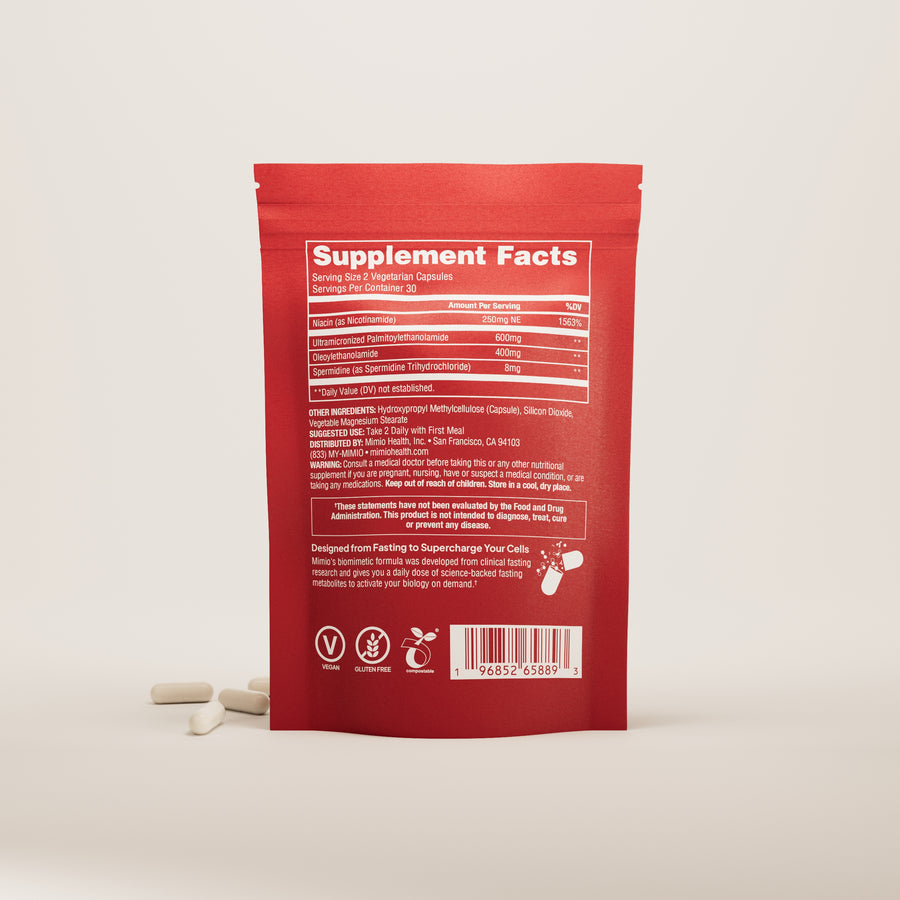
Mimio Biomimetic Cell Care isn't a long-fast aid, and it doesn't make a 72 hour fast safer. It's a daily supplement with four active ingredients, spermidine, nicotinamide, PEA and OEA, that trace back to the study behind Mimio: Dr. Rhodes's 36 hour fasting study at UC Davis, in which blood levels of spermidine, PEA, OEA and a nicotinamide metabolite rose during the fast.²⁹ That study stopped at 36 hours, so it can't tell us what happens at hour 72.
The label directs two capsules with your first meal, so Mimio belongs on your eating days, alongside the basics above. Review the full formula on the Mimio product page.
The Bottom Line
A 72 hour fast reliably moves your body onto fat and ketones, but the scale drop is mostly water, insulin sensitivity falls for a while rather than resetting, and autophagy in people is unproven. If you do one, prepare, keep sodium and fluids up, break it gently and get medical advice first if any risk factor applies.
Questions People Ask About the 72 Hour Fast
Is it healthy to do 72 hours fasting?
For healthy, well-nourished adults who prepare, a single 72 hour fast is usually tolerated, but it isn't risk-free. In a review of 768 medically supervised water-only fasts lasting two days or longer, three quarters of side effects were mild and 2 visits involved a serious adverse event, yet more than a quarter of visits included at least one severe (grade 3) event.³⁰ And tolerated isn't the same as better: benefits beyond a shorter fast aren't established, and it isn't for the groups listed above.
Will I lose belly fat if I fast for 2 days?
Very little. Even after a full week without food, deep belly (visceral) fat didn't change significantly in a study of 12 adults, and total fat loss averaged 1.6 kg.⁶ Two days mostly lowers water and glycogen. Belly fat comes off with overall fat loss over weeks.
Does a 3 day fast reset your gut?
Not in any proven way. Fasting does shift gut bacteria: during a 10-day, roughly 250-calorie-a-day fast in 15 healthy men, fiber-digesting bacteria declined and bacteria that feed on the body's own substances increased, but the changes had reversed three months later.³¹ We found no study of the gut microbiome after a 72 hour fast specifically, so "reset" claims go beyond the evidence.
Can you drink coffee during a 72 hour fast?
Yes. Johns Hopkins Medicine lists black coffee among the zero-calorie drinks allowed while fasting.¹ Keep to your usual amount, since stopping suddenly can bring withdrawal headaches within 12 to 24 hours.¹² For most adults, the FDA cites up to 400 mg of caffeine a day, about two to three 12-ounce cups, as not generally linked to negative effects.³² Milk, cream and sugar add calories.
What is the 72 hour fast test in a hospital?
It's a diagnostic test, not a wellness fast. Doctors use a supervised, water-only 72 hour fast to investigate unexplained low blood sugar, such as from an insulin-producing tumor (insulinoma). It's done in hospital with regular blood tests and stopped early if blood sugar falls below a set level.³³
This article is for general education and does not replace individualized medical advice. Talk with your clinician before a fast of 72 hours, especially if you take medication, are pregnant or breastfeeding, or have a health condition.
These statements have not been evaluated by the Food and Drug Administration. This product is not intended to diagnose, treat, cure, or prevent any disease.
References
- Johns Hopkins Medicine. Intermittent fasting: what is it, and how does it work? Health library.
- Koppold DA, Breinlinger C, Hanslian E, et al. International consensus on fasting terminology. Cell Metab. 2024;36(8):1779-1794.e4. doi:10.1016/j.cmet.2024.06.013.
- Rothman DL, Magnusson I, Katz LD, et al. Quantitation of hepatic glycogenolysis and gluconeogenesis in fasting humans with 13C NMR. Science. 1991;254(5031):573-576. doi:10.1126/science.1948033.
- Bak AM, Vendelbo MH, Christensen B, et al. Prolonged fasting-induced metabolic signatures in human skeletal muscle of lean and obese men. PLoS One. 2018;13(9):e0200817. doi:10.1371/journal.pone.0200817.
- Anton SD, Moehl K, Donahoo WT, et al. Flipping the metabolic switch: understanding and applying the health benefits of fasting. Obesity (Silver Spring). 2018;26(2):254-268. doi:10.1002/oby.22065.
- Pietzner M, Uluvar B, Kolnes KJ, et al. Systemic proteome adaptions to 7-day complete caloric restriction in humans. Nat Metab. 2024;6(4):764-777. doi:10.1038/s42255-024-01008-9.
- Alirezaei M, Kemball CC, Flynn CT, et al. Short-term fasting induces profound neuronal autophagy. Autophagy. 2010;6(6):702-710. doi:10.4161/auto.6.6.12376.
- Webber J, Macdonald IA. The cardiovascular, metabolic and hormonal changes accompanying acute starvation in men and women. Br J Nutr. 1994;71(3):437-447. doi:10.1079/bjn19940150.
- Hartman ML, Veldhuis JD, Johnson ML, et al. Augmented growth hormone (GH) secretory burst frequency and amplitude mediate enhanced GH secretion during a two-day fast in normal men. J Clin Endocrinol Metab. 1992;74(4):757-765. doi:10.1210/jcem.74.4.1548337.
- Vendelbo MH, Møller AB, Christensen B, et al. Fasting increases human skeletal muscle net phenylalanine release and this is associated with decreased mTOR signaling. PLoS One. 2014;9(7):e102031. doi:10.1371/journal.pone.0102031.
- Natalucci G, Riedl S, Gleiss A, et al. Spontaneous 24-h ghrelin secretion pattern in fasting subjects: maintenance of a meal-related pattern. Eur J Endocrinol. 2005;152(6):845-850. doi:10.1530/eje.1.01919.
- Juliano LM, Griffiths RR. A critical review of caffeine withdrawal: empirical validation of symptoms and signs, incidence, severity, and associated features. Psychopharmacology (Berl). 2004;176(1):1-29. doi:10.1007/s00213-004-2000-x.
- Kerndt PR, Naughton JL, Driscoll CE, Loxterkamp DA. Fasting: the history, pathophysiology and complications. West J Med. 1982;137(5):379-399. PMID: 6758355.
- Ding XQ, Maudsley AA, Schweiger U, et al. Effects of a 72 hours fasting on brain metabolism in healthy women studied in vivo with magnetic resonance spectroscopic imaging. J Cereb Blood Flow Metab. 2018;38(3):469-478. doi:10.1177/0271678X17697721.
- Vendelbo MH, Clasen BF, Treebak JT, et al. Insulin resistance after a 72-h fast is associated with impaired AS160 phosphorylation and accumulation of lipid and glycogen in human skeletal muscle. Am J Physiol Endocrinol Metab. 2012;302(2):E190-E200. doi:10.1152/ajpendo.00207.2011.
- Bouck T, Marcotte-Chénard A, Barg D, et al. Fasting-induced glucose intolerance is not impacted by the addition of daily exercise: a randomized crossover study. J Physiol. 2026;604(15):6391-6404. doi:10.1113/JP291000.
- Bensalem J, Teong XT, Hattersley KJ, et al. Intermittent time-restricted eating may increase autophagic flux in humans: an exploratory analysis. J Physiol. 2025;603(10):3019-3032. doi:10.1113/JP287938.
- Cheng CW, Adams GB, Perin L, et al. Prolonged fasting reduces IGF-1/PKA to promote hematopoietic-stem-cell-based regeneration and reverse immunosuppression. Cell Stem Cell. 2014;14(6):810-823. doi:10.1016/j.stem.2014.04.014.
- Dorff TB, Groshen S, Garcia A, et al. Safety and feasibility of fasting in combination with platinum-based chemotherapy. BMC Cancer. 2016;16:360. doi:10.1186/s12885-016-2370-6.
- Masedunskas A, de Ciutiis I, Hein LK, et al. Investigating the impact of glycogen-depleting exercise combined with prolonged fasting on autophagy and cellular health in humans: a randomised controlled crossover trial. Nutrients. 2024;16(24):4297. doi:10.3390/nu16244297.
- Kreitzman SN, Coxon AY, Szaz KF. Glycogen storage: illusions of easy weight loss, excessive weight regain, and distortions in estimates of body composition. Am J Clin Nutr. 1992;56(1 Suppl):292S-293S. doi:10.1093/ajcn/56.1.292S.
- National Institute of Diabetes and Digestive and Kidney Diseases. Fasting safely with diabetes. Expert Q&A.
- US Food and Drug Administration. Sodium in your diet: use the Nutrition Facts label and reduce your intake. Content current as of March 5, 2024. Consumer guidance.
- National Institutes of Health, Office of Dietary Supplements. Potassium: fact sheet for health professionals. Updated June 2, 2022. Fact sheet.
- National Institutes of Health, Office of Dietary Supplements. Magnesium: fact sheet for health professionals. Updated January 6, 2026. Fact sheet.
- Mehanna HM, Moledina J, Travis J. Refeeding syndrome: what it is, and how to prevent and treat it. BMJ. 2008;336(7659):1495-1498. doi:10.1136/bmj.a301.
- da Silva JSV, Seres DS, Sabino K, et al. ASPEN consensus recommendations for refeeding syndrome. Nutr Clin Pract. 2020;35(2):178-195. doi:10.1002/ncp.10474.
- National Institute for Health and Care Excellence. Nutrition support for adults: oral nutrition support, enteral tube feeding and parenteral nutrition. Clinical guideline CG32. Published 2006, updated 2017. Guideline.
- Rhodes CH, Zhu C, Agus J, et al. Human fasting modulates macrophage function and upregulates multiple bioactive metabolites that extend lifespan in Caenorhabditis elegans: a pilot clinical study. Am J Clin Nutr. 2023;117(2):286-297. doi:10.1016/j.ajcnut.2022.10.015.
- Finnell JS, Saul BC, Goldhamer AC, Myers TR. Is fasting safe? A chart review of adverse events during medically supervised, water-only fasting. BMC Complement Altern Med. 2018;18(1):67. doi:10.1186/s12906-018-2136-6.
- Mesnage R, Grundler F, Schwiertz A, et al. Changes in human gut microbiota composition are linked to the energy metabolic switch during 10 d of Buchinger fasting. J Nutr Sci. 2019;8:e36. doi:10.1017/jns.2019.33.
- US Food and Drug Administration. Spilling the beans: how much caffeine is too much? Content current as of August 28, 2024. Consumer update.
- Norfolk and Norwich University Hospitals NHS Foundation Trust, James Paget University Hospital NHS Trust and Queen Elizabeth Hospital King's Lynn NHS Foundation Trust. Joint Trust guideline for 72 hour fast for investigation of spontaneous hypoglycaemia. Version 3, approved August 30, 2023. Clinical guideline.