If creatine is part of your daily routine, fasting raises an obvious question: does that scoop break your fast? For plain creatine monohydrate, the research is reassuring, with one honest gap. Here's what studies show about calories, insulin, ketosis and autophagy, and when to take creatine if you fast.
Quick answer: Plain creatine monohydrate doesn't break a fast for most goals. Your body doesn't burn it for fuel, and in a controlled study, 5 grams of creatine alone didn't raise insulin. No one has tested its effect on autophagy in fasting people. Gummies and flavored powders are different: added sugar or fillers can break a fast. If you want zero doubt, take creatine with your first meal.
Does Creatine Break a Fast? It Depends on Your Goal
For calories, insulin and ketosis, plain creatine monohydrate doesn't appear to break a fast. For autophagy, nobody knows yet. And on a strict water fast, anything besides water breaks the rules. Our guide to what breaks a fast covers other common foods, drinks and supplements.
Your fasting goal |
Plain creatine monohydrate |
Why |
|---|---|---|
Calories, weight or fat loss |
Doesn't break it |
Your body stores creatine and then clears it; it isn't burned as fuel¹˒² |
Insulin and blood sugar |
Unlikely to break it |
5 grams of creatine alone didn't change insulin³ |
Ketosis |
Unlikely to break it |
No carbohydrate and no insulin rise, though we found no study that measured ketones directly³˒⁴ |
Autophagy |
Unknown |
No study has tested it in fasting people; take it with your first meal if this is your priority |
Strict water, religious or medical fast |
Breaks the rules |
Water only means water only; follow your protocol |
Asked whether people can take creatine during a fast, Dr. Chris Rhodes, PhD, Mimio's CEO and scientific founder, kept it short: "Creatine doesn't actually have calories." His caveat matches the research: that holds only when the product doesn't add other ingredients that do.
Does Creatine Have Calories?
Plain creatine monohydrate has no calories your body can use. Your liver and kidneys make creatine from the amino acids arginine, glycine and methionine, and about 95% of the creatine in your body sits in your muscles.¹˒²
What matters for fasting is what happens to a dose. About 99% of the creatine monohydrate you swallow is either taken up by your tissues or passed in urine. The creatine you store then breaks down slowly, about 1% to 2% a day, into creatinine, a waste product your kidneys clear.¹˒² In other words, your body stores creatine and then gets rid of it. It doesn't burn it for energy the way it burns carbohydrate, fat or protein.
You'll sometimes see creatine estimated at about 4 calories per gram, the figure for protein. That math assumes your body burns creatine like protein, and it doesn't.
Labels add one wrinkle. Under FDA rules, a Supplement Facts panel has to list calories only when a serving has 5 or more, so a label with no calorie line can still mean fewer than 5 per serving.⁵
Creatine Gummies, Flavored Powders and Premixed Drinks
The creatine isn't the problem; the extras are. Read the Supplement Facts panel and the "Other ingredients" line before you take any creatine product while fasting. Our guide to which supplements break a fast explains how to read the label.
Product |
Breaks a fast? |
What to check |
|---|---|---|
Unflavored creatine monohydrate powder |
No |
The only ingredient should be creatine monohydrate |
Creatine capsules |
Usually not |
The "Other ingredients" line for fillers and coatings |
Flavored powders |
Often |
Total carbohydrate, sugars, dextrose or maltodextrin |
Gummies |
Usually |
Calories and sugars for the full serving size |
Pre-workouts and creatine blends |
Often |
Amino acids such as BCAAs, carbohydrate and calories |
Ready-to-drink creatine |
Check closely |
Creatine breaks down in liquid, so stable drinks with a full dose have been hard to make² |
What you mix it into matters just as much. Juice, milk or a protein shake breaks a fast even when the creatine doesn't. Water, black coffee or plain tea keeps it intact for most goals.
Does Creatine Spike Insulin?
Not on its own. In human studies, insulin rose only when creatine came with a big serving of carbohydrate, or carbohydrate and protein.³˒¹⁴
In the clearest test, 24 men took 5 grams of creatine in a drink four times a day for five days, and one group also drank 93 grams of simple sugar 30 minutes after each dose. Creatine alone didn't change insulin. With the sugar, insulin rose sharply, and muscle creatine rose 60% more.³ Later studies point the same way:
Study |
Who |
What they took |
What happened to insulin |
|---|---|---|---|
Newman, 2003⁶ |
17 healthy, untrained men |
20 grams a day for 5 days, then 3 grams a day for 28 days |
No change in glucose tolerance or insulin sensitivity |
Rooney, 2003⁷ |
Vegetarians |
5 grams a day for 6 weeks |
Same insulin response to a glucose drink, though blood sugar after it ran somewhat higher |
Delpino, 2022⁸ |
Review of 9 studies |
Various doses |
No significant effect on fasting blood sugar or insulin resistance |
None of these studies tested creatine during a fast, so this part is an inference: a dose that doesn't move insulin in everyday conditions is unlikely to move it while you fast.
Does Creatine Break Ketosis?
Probably not, though we found no study that measured ketones after creatine. Ketosis deepens as a fast goes on, while insulin falls and glucagon, a hormone that signals the liver to release fuel, rises.⁹ That matters because insulin switches ketone production down and glucagon switches it up.⁴
Plain creatine has no carbohydrate and didn't raise insulin in testing,³ so it gives your liver no reason to stop making ketones. A sweetened creatine drink is a different story. If you're new to ketones, here's how ketosis works.
Does Creatine Mess Up Autophagy?
No one knows for sure, because no study has tested creatine and autophagy in people who are fasting. What we do know points to low risk.
Autophagy is your cells' recycling program. A nutrient sensor called mTOR switches it down when insulin and certain amino acids, such as leucine and arginine, signal that food has arrived.¹⁰ Plain creatine didn't raise insulin in testing,³ and it isn't one of those signaling amino acids.
The few lab studies that connect creatine and autophagy point the other way. In human stem cells grown in a dish and in mice fed a high-fat diet, creatine increased markers of autophagy.¹¹˒¹² Cells and mice aren't fasting people, so treat that as a hint, not an answer.
Even fasting's effect on autophagy is best documented in animals. A 2025 trial that measured autophagy in human blood cells found only an exploratory signal after six months of intermittent fasting.¹³ For the bigger picture, see how fasting triggers autophagy.
If autophagy is the main reason you fast, the cautious move costs you nothing: take creatine with your first meal.
When to Take Creatine If You Fast
Take it at a time you'll remember every day. Consistency matters more than the hour, because muscle creatine builds over weeks and, once raised, takes about four to six weeks to drift back down.¹
- With your first meal: the simplest option. Taking creatine with carbohydrate, or carbohydrate and protein, helps your body keep more of it.¹ In one study, pairing each dose with about 50 grams each of protein and carbohydrate raised creatine retention by about 25%, though the insulin effect weakened within the first day of supplementing.¹⁴
- During the fast: fine if your stomach handles it. Stick to 5 grams or less at a time; a single 10 gram dose caused diarrhea more often than two 5 gram doses.¹⁵ Creatine doesn't dissolve easily: room temperature water holds only about 14 grams per liter, so stir a 5 gram dose into at least a full glass, about 12 ounces.²
- Around workouts: some studies favor taking creatine after training rather than before, but a 2021 review found the evidence too limited for firm conclusions.¹⁶ For training on an empty stomach, see our guide to working out while fasting.
Fasting pattern |
Simplest time to take creatine |
|---|---|
16:8 or 18:6 |
With your first meal |
OMAD or 20:4 |
With your one meal |
24 to 36 hour fasts |
With the meal that ends the fast, or in water during the fast |
Two to three days |
Pause it, or keep taking plain creatine in water |
Longer than three days |
Follow your supervising clinician |
Religious fasts with nothing by mouth |
With your predawn or evening meal |
Still choosing a pattern? Our intermittent fasting schedule guide walks through the options.
How Much Creatine to Take on a Fasting Schedule
Three to five grams a day is the standard daily dose once your muscles are full.¹˒²
Loading, about 20 grams a day split into four 5 gram doses for five to seven days, fills muscle faster.¹ But 3 grams a day reaches the same level in about four weeks.¹⁷ If you fast, skipping the loading phase makes sense. Big single doses are more likely to upset your stomach,¹⁵ and loading typically adds 1 to 3 kilograms (about 2 to 7 pounds), mostly water,² which can muddy the scale if you track your weight.
Creatine, Hydration and Electrolytes While Fasting
Creatine draws water into your muscles, while fasting makes your body shed sodium and water. Together, that's a good reason to drink steadily.
Early in a fast, much of the quick drop on the scale comes from lost sodium.⁹ Creatine, meanwhile, moves into muscle with the help of sodium, and water follows, mostly into the muscle cells themselves.²
Controlled studies haven't found that creatine causes dehydration or muscle cramps.¹˒² MedlinePlus still lists dehydration, upset stomach and muscle cramps as possible side effects,¹⁸ so cover the basics:
- Drink a full glass of water with each dose.
- On fasts longer than a day, pay attention to sodium. Our guide to what to drink while fasting covers electrolyte drinks.
Can You Take Creatine on a Water Fast or an Extended Fast?
On a strict water fast, no: water only means water only. The good news is that a short pause costs you very little.
Muscle creatine falls slowly once you stop. In one study, levels took about 30 days to return to baseline after supplements stopped, and a major review puts it at four to six weeks.¹˒¹⁷ For a fast of two or three days, the simplest plan is to stop, then restart your usual daily dose with your first meal. You don't need to load again. Our guide to what to eat after a fast covers that first meal.
Two more things matter on longer fasts:
- Blood tests: creatine can raise blood creatinine, the marker routine panels use to estimate kidney function, which can make results look worse than they are.² Tell whoever orders your labs that you take it.
- Medical supervision: long fasts carry their own risks, including blood pressure drops on standing, heart rhythm problems, gout and kidney stones from uric acid.⁹ Do fasts longer than three days only with medical supervision. Our guide to the types of fasting explains how water fasting differs from other approaches.
Who Should Skip Creatine or Check With a Clinician First
Creatine is well studied and well tolerated by healthy adults at standard doses.¹˒² Talk with a clinician before combining it with fasting if any of these apply:
- Kidney disease. Creatine might make existing kidney disease worse.¹⁸ In healthy people, controlled studies haven't found kidney harm at recommended doses.²
- Pregnancy or breastfeeding. There isn't enough reliable safety information, so MedlinePlus advises avoiding it.¹⁸
- Bipolar disorder. Creatine might make mania worse.¹⁸
- Parkinson's disease. Caffeine and creatine together may worsen symptoms, which matters if you take creatine in coffee.¹⁸
- Diabetes medicines. In a 12-week trial of people with type 2 diabetes who were also exercising, creatine lowered HbA1c, a three-month blood sugar average, more than placebo did.¹⁹ If you take insulin or other glucose-lowering drugs, plan fasting and creatine with your care team.
- Any prescription medicine. It isn't known whether creatine interacts with medicines, so ask first.¹⁸
With a current or past eating disorder, or if you're under 18, skip fasting altogether.
Where Mimio Fits
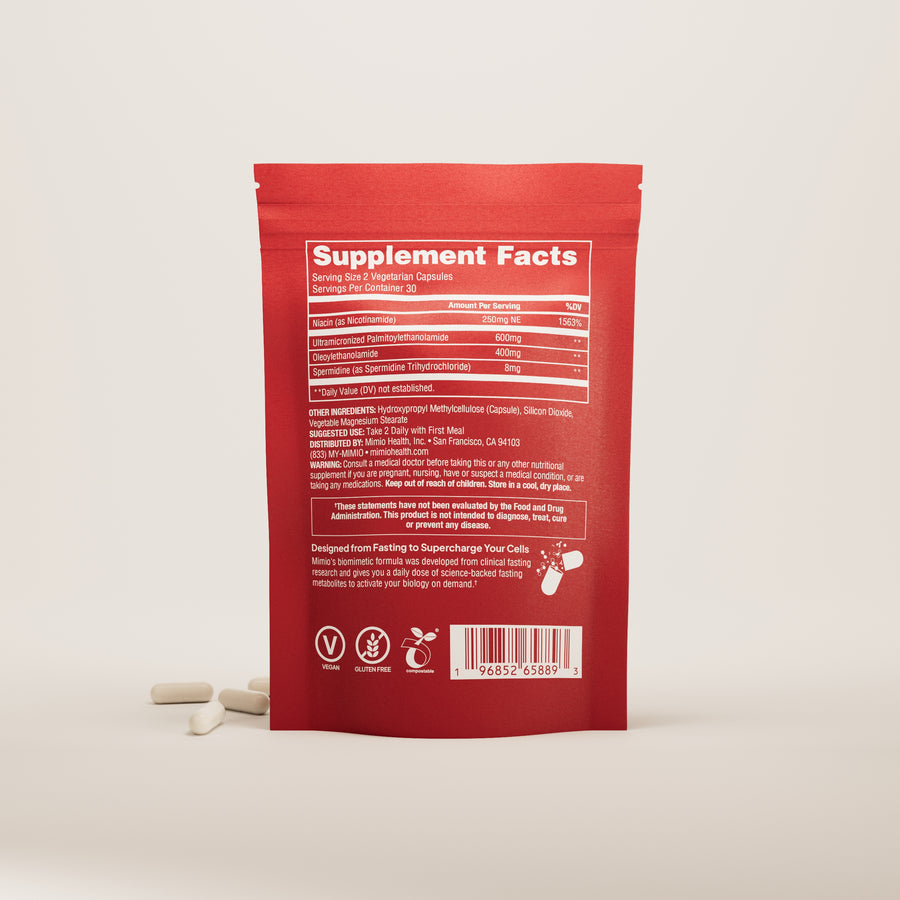
Mimio Biomimetic Cell Care isn't creatine or a sports supplement. It's a daily supplement with four active ingredients, spermidine, nicotinamide, PEA and OEA, that trace back to the study behind Mimio: Dr. Rhodes's 36 hour fasting study at UC Davis, in which blood levels of spermidine, PEA, OEA and a nicotinamide metabolite rose during the fast.²⁰
The label directs two capsules with your first meal, the same slot this guide suggests for creatine. Review the full formula on the Mimio product page, and see our fasting supplements guide for how other supplements fit around a fast.
The Bottom Line
Plain creatine monohydrate is one of the easiest supplements to keep on a fasting schedule. It has no calories your body can use, didn't raise insulin in testing, and is unlikely to affect ketosis. Autophagy is the open question, so if that's your priority, take it with your first meal. Skip sugary gummies and flavored mixes during the fast, drink enough water, and pause creatine on strict water fasts. For how it compares with other options, see our roundup of intermittent fasting supplements.
Questions People Ask About Creatine and Fasting
Does 5g of creatine break a fast?
No, not if it's plain creatine monohydrate in water. Five grams is the dose that left insulin unchanged in the classic study,³ and your body stores or clears creatine rather than burning it.² A flavored 5 gram scoop can be different, so check the label.
Can I take creatine on an empty stomach?
Yes, most people can. Stomach upset is more likely with big single doses: in a 28-day trial of 59 soccer players, one 10 gram dose a day caused diarrhea more often than two 5 gram doses.¹⁵ If creatine bothers your stomach, move it to your first meal.
Can I mix creatine with black coffee while fasting?
Yes, for most fasting goals. Warm liquid helps creatine dissolve, and early creatine studies served it in hot tea.² MedlinePlus notes that caffeine might reduce creatine's benefits for athletic performance, and people with Parkinson's disease should be careful with the combination.¹⁸
Should I take creatine before fasting blood work?
Usually not. Fasting for blood work generally means plain water only for 8 to 12 hours, and you should ask your provider about supplements.²¹ Creatine can also raise blood creatinine, a kidney marker on routine panels.² Ask whether to pause it before the draw.
This article is for general education and does not replace individualized medical advice. Talk with your clinician before fasting or taking creatine if you take medication, are pregnant or breastfeeding, or have a health condition.
These statements have not been evaluated by the Food and Drug Administration. This product is not intended to diagnose, treat, cure, or prevent any disease.
References
- Kreider RB, Kalman DS, Antonio J, et al. International Society of Sports Nutrition position stand: safety and efficacy of creatine supplementation in exercise, sport, and medicine. J Int Soc Sports Nutr. 2017;14:18. doi:10.1186/s12970-017-0173-z.
- Antonio J, Candow DG, Forbes SC, et al. Common questions and misconceptions about creatine supplementation: what does the scientific evidence really show? J Int Soc Sports Nutr. 2021;18(1):13. doi:10.1186/s12970-021-00412-w.
- Green AL, Hultman E, Macdonald IA, et al. Carbohydrate ingestion augments skeletal muscle creatine accumulation during creatine supplementation in humans. Am J Physiol. 1996;271(5 Pt 1):E821-E826. doi:10.1152/ajpendo.1996.271.5.E821.
- Puchalska P, Crawford PA. Multi-dimensional roles of ketone bodies in fuel metabolism, signaling, and therapeutics. Cell Metab. 2017;25(2):262-284. doi:10.1016/j.cmet.2016.12.022.
- US Code of Federal Regulations. 21 CFR 101.36(b)(2)(i), Nutrition labeling of dietary supplements, and 21 CFR 101.9(c)(1), Nutrition labeling of food. eCFR.
- Newman JE, Hargreaves M, Garnham A, et al. Effect of creatine ingestion on glucose tolerance and insulin sensitivity in men. Med Sci Sports Exerc. 2003;35(1):69-74. doi:10.1097/00005768-200301000-00012.
- Rooney KB, Bryson JM, Digney AL, et al. Creatine supplementation affects glucose homeostasis but not insulin secretion in humans. Ann Nutr Metab. 2003;47(1):11-15. doi:10.1159/000068908.
- Delpino FM, Figueiredo LM. Does creatine supplementation improve glycemic control and insulin resistance in healthy and diabetic patients? A systematic review and meta-analysis. Clin Nutr ESPEN. 2022;47:128-134. doi:10.1016/j.clnesp.2021.11.006.
- Kerndt PR, Naughton JL, Driscoll CE, et al. Fasting: the history, pathophysiology and complications. West J Med. 1982;137(5):379-399. PMID: 6758355.
- Saxton RA, Sabatini DM. mTOR signaling in growth, metabolism, and disease. Cell. 2017;168(6):960-976. doi:10.1016/j.cell.2017.02.004.
- Liu L, Chu Z, Han X, et al. Creatine promotes osteogenic differentiation of dental pulp stem cells via the AMPK-ULK1-autophagy axis. Connect Tissue Res. 2025;66(2):73-86. doi:10.1080/03008207.2025.2459243.
- Chen Y, Jiang Y, Cui T, et al. Creatine ameliorates high-fat diet-induced obesity by regulation of lipolysis and lipophagy in brown adipose tissue and liver. Biochimie. 2023;209:85-94. doi:10.1016/j.biochi.2023.02.004.
- Bensalem J, Teong XT, Hattersley KJ, et al. Intermittent time-restricted eating may increase autophagic flux in humans: an exploratory analysis. J Physiol. 2025;603(10):3019-3032. doi:10.1113/JP287938.
- Steenge GR, Simpson EJ, Greenhaff PL. Protein- and carbohydrate-induced augmentation of whole body creatine retention in humans. J Appl Physiol. 2000;89(3):1165-1171. doi:10.1152/jappl.2000.89.3.1165.
- Ostojic SM, Ahmetovic Z. Gastrointestinal distress after creatine supplementation in athletes: are side effects dose dependent? Res Sports Med. 2008;16(1):15-22. doi:10.1080/15438620701693280.
- Ribeiro F, Longobardi I, Perim P, et al. Timing of creatine supplementation around exercise: a real concern? Nutrients. 2021;13(8):2844. doi:10.3390/nu13082844.
- Hultman E, Söderlund K, Timmons JA, et al. Muscle creatine loading in men. J Appl Physiol. 1996;81(1):232-237. doi:10.1152/jappl.1996.81.1.232.
- MedlinePlus. Creatine (Natural Medicines monograph). US National Library of Medicine. Last reviewed November 2, 2026. Herbs and supplements.
- Gualano B, de Salles Painneli V, Roschel H, et al. Creatine in type 2 diabetes: a randomized, double-blind, placebo-controlled trial. Med Sci Sports Exerc. 2011;43(5):770-778. doi:10.1249/MSS.0b013e3181fcee7d.
- Rhodes CH, Zhu C, Agus J, et al. Human fasting modulates macrophage function and upregulates multiple bioactive metabolites that extend lifespan in Caenorhabditis elegans: a pilot clinical study. Am J Clin Nutr. 2023;117(2):286-297. doi:10.1016/j.ajcnut.2022.10.015.
- Cleveland Clinic. Fasting for blood work. Updated December 10, 2024. Health library.