It's 9 a.m., you're 14 hours into your fast, and there's a vitamin in your hand. Does swallowing it undo the morning? Usually not. Here's how to tell which supplements break a fast, a table covering 16 common ones, and when to take each so your fast and your supplements both do their job.
Quick answer: Most vitamin and mineral tablets and capsules don't break a fast. They hold fewer than 5 calories and no meaningful protein or sugar. Gummies, protein powder, collagen and amino acids do, and oils such as fish oil and MCT oil add fat calories. Fat soluble vitamins don't break a fast either, but they're best taken with a meal that contains some fat.
How to Tell If a Supplement Breaks Your Fast
A supplement breaks a fast when it brings in meaningful energy or tells your cells that food has arrived. Three questions sort almost anything in your cabinet.
- Does it contain calories? Sugar, oils and other fats are the usual sources. A capsule of dry powder carries next to nothing. A gummy or an oil softgel carries a few calories or more.
- Does it contain protein or amino acids? Protein powders, collagen, BCAAs and EAAs all do. They matter most if you fast for autophagy, because amino acids are a signal your cells' nutrient sensors respond to.¹
- Will it sit well on an empty stomach? This one isn't about breaking the fast. Iron, for example, can cause cramps and nausea in some people, and a little food helps.²
What the label tells you
Start with the Supplement Facts panel. In the US, it lists calories only when a serving holds 5 or more; anything less is left off.³ So no calorie line means close to zero, not exactly zero. Then scan the ingredients for sugar, fruit juice, maltodextrin, oils, gelatin or added amino acids, which is where calories and "fed" signals hide.
Your fasting goal decides how strict to be
If you fast for weight or blood sugar, the few calories in a fish oil capsule barely register. If you fast for gut rest or autophagy, keep the window clean and move anything borderline to your first meal. Foods follow the same logic, and our guide to what breaks a fast covers them goal by goal. For coffee, tea and electrolyte drinks, see what to drink while fasting.
Which Supplements Break a Fast? The Full Table
Most vitamins and minerals don't break a fast; protein, collagen, amino acids, gummies and oils do. Here's how 16 common supplements line up, plus prescription medicines. "Breaks a strict fast" means any calories, protein or amino acids, the standard for gut rest or autophagy; for weight goals, a few calories rarely matter.
Supplement |
Breaks a strict fast? |
Best time to take it |
|---|---|---|
Multivitamin (tablet or capsule) |
No. Labels list no calories, so under 5 per serving³˒⁴ |
Either window. With your first meal if it upsets your stomach |
Gummy vitamins |
Yes. Usually 2 to 8 grams of sugar per serving⁵ |
With a meal |
B vitamins and vitamin C |
No. Labels list no calories⁴ |
Either window. With food if they make you queasy |
Vitamin D, A, E and K softgels |
No, in practice. A drop of oil, too little to list⁴ |
With a meal that contains some fat⁶ |
Magnesium |
No, if unsweetened⁴ |
Any time. With food if it upsets your stomach |
Electrolytes, sugar-free |
No. Capsules list no calories⁴ |
During the fast, especially a longer one⁷ |
Iron |
No |
Empty stomach absorbs best; add a little food if it causes nausea. Not with coffee² |
Zinc |
No |
With food if it makes you nauseous |
Fish oil (1,000 mg softgel) |
Technically, yes. About 10 calories of fat⁴ |
With a meal |
Creatine monohydrate, plain |
No, in practice. No sugar, fat or protein⁴˒⁸ |
Any time. With your first meal for a strict fast |
Collagen peptides |
Yes. About 35 to 40 calories per 10 grams, nearly all protein⁴ |
Eating window |
Protein powder |
Yes |
Eating window |
BCAAs and EAAs |
Yes. Amino acids signal "fed" to your cells¹ |
Eating window |
Psyllium and other fiber powders |
Yes, a little. Psyllium powders list about 20 to 30 calories per serving, and fiber puts your gut to work⁴˒⁹ |
Eating window, especially for gut rest |
Probiotics (capsules) |
No. Labels list no calories⁴ |
As the label directs |
MCT oil |
Yes. 100 to 130 calories per tablespoon⁴ |
Eating window |
Prescription medication |
Never a reason to skip a dose |
Exactly as prescribed |
Calorie values come from supplement labels in the NIH Dietary Supplement Label Database and vary by product, so check yours.⁴
Do Vitamins Break a Fast?
Mostly, no. Vitamin tablets and capsules carry next to no calories, so the real questions are comfort and absorption.
Multivitamins, B vitamins and vitamin C
Multivitamin tablets, B vitamins and vitamin C typically list no calories on their labels, which means each serving holds fewer than 5.³˒⁴ They fit any fasting goal. If a tablet makes you queasy on an empty stomach, take it with your first meal. Taking it every day matters more than perfect timing. If you take a B3 form for NAD+, our comparison of NR, NMN and nicotinamide covers doses and side effects.
Fat soluble vitamins: A, D, E and K
These often come in softgels with a drop of oil, too little to appear on the label.⁴ They don't meaningfully break a fast, but they dissolve in fat, and at least for vitamin D, fat at the meal makes a real difference. In a study of 50 older adults, peak blood levels of vitamin D3 were 32% higher when the dose came with a meal containing fat than with a fat-free meal.⁶ A meal with some fat is their natural home.
Do gummy vitamins break a fast?
Usually, yes. Gummies are the exception among vitamins. Most contain 2 to 8 grams of sugar per serving, and their base usually includes gelatin, which is protein.⁵ Typical adult multivitamin gummies list about 15 calories per serving.⁴ Sugar-free versions often use sugar alcohols or fruit juice instead.⁵ Treat any gummy as food and take it with a meal.
Do Minerals Break a Fast? Magnesium, Electrolytes, Iron and Zinc
Plain minerals don't break a fast, because they carry no calories. What matters is the dose, the form and how your stomach handles them.
Does magnesium break a fast?
No. Plain, unsweetened magnesium capsules and tablets list no calories.⁴ Check powders and drink mixes for sweeteners or maltodextrin. Keep supplements at or below 350 mg a day, the upper limit for adults, since high doses can cause diarrhea, nausea and cramping.¹⁰ The citrate, chloride, lactate and aspartate forms tend to be absorbed better than magnesium oxide or sulfate.¹⁰
Electrolytes
Sugar-free electrolytes don't break a fast,⁴ and sodium and potassium matter more the longer you fast. In a small controlled study, men eating a third of their energy needs for 48 hours kept their plasma volume steady, and more of their exercise capacity in the heat, when they also got sodium and potassium.⁷ Our guide to electrolytes for fasting explains how much to take and what to look for in an electrolyte supplement.
If you have kidney disease or take medicines such as ACE inhibitors or potassium-sparing diuretics, ask your clinician before using potassium: even modest amounts can raise blood potassium too high.¹¹
Iron and zinc
Neither has calories. Iron is best absorbed on an empty stomach, but it can cause cramps, nausea and diarrhea, and taking it with a small amount of food can help. MedlinePlus also advises not taking iron at the same time as coffee or other caffeinated drinks, and waiting at least 2 hours after milk, calcium or antacids before you take it.² If your fast includes black coffee, take iron at a different time.
Too much zinc can cause nausea, stomach upset and vomiting.¹² If zinc bothers you on an empty stomach, take it with food.
Do Protein Powder, Collagen and BCAAs Break a Fast?
Yes. This is the category that clearly breaks a fast. Protein powder is food in powdered form. Collagen is protein too: unflavored collagen peptides list about 35 to 40 calories per 10 gram serving.⁴ BCAAs and EAAs are individual amino acids, the building blocks of protein.
The reason goes beyond calories. Your cells read amino acids as a sign that nutrients are available, through a sensing hub called mTORC1 that helps decide whether a cell builds or recycles. In cell studies, leucine, one of the three BCAAs, suppressed autophagy, the cell's recycling process, by switching on mTORC1.¹ That's why protein is the first thing to move out of an autophagy-focused fast. Labels can understate this, too: products made only of individual amino acids aren't allowed to list protein on the Supplement Facts panel at all.³
None of this makes protein the enemy. Just give it its own time: your first meal is the right place for a shake or a scoop of collagen, and our guide to what to eat after a fast covers how to build that meal.
Does creatine break a fast?
Not in any practical sense; our creatine and fasting guide has the full answer. Creatine is a non-protein amino acid compound, and the usual maintenance dose is 3 to 5 grams a day.⁸ Plain creatine monohydrate labels list no calories, sugar, fat or protein.⁴ For a strict autophagy fast, there's no downside to taking it with your first meal instead. Flavored powders and gummies are a different story, so check the label. Our roundup of intermittent fasting supplements explains how active fasters use creatine.
Do Fish Oil and MCT Oil Break a Fast?
Yes, to different degrees. Oils carry real calories, at about 9 per gram of fat, so they end a strict fast.³ How much that matters depends on the dose.
Does fish oil break a fast?
Technically, yes. A standard 1,000 mg fish oil softgel holds about 1 gram of fat, and labels list about 10 calories.⁴ That ends a strict zero calorie fast but barely registers for weight goals. Fish oil's common side effects include an unpleasant taste, heartburn, nausea and stomach upset.¹³ Between the calories and the side effects, your first meal is the simple place for it.
MCT oil and fasting coffee
MCT oil ends a fast by any definition. A tablespoon is about 14 grams of fat, which labels list at 100 to 130 calories.⁴ It has no carbohydrate or protein, which is why some people stir it into coffee to stretch a morning fast. That makes it a small breakfast, not a supplement.
Fiber and Probiotics
Fiber supplements put your gut to work, so they don't fit a gut-rest fast. Probiotic capsules carry almost nothing.
Psyllium forms a gel that holds water in the bowel, and soluble fibers such as inulin are fermented by gut bacteria.⁹ Psyllium powders list about 20 to 30 calories per serving.⁴ Keep fiber for your eating window, especially if you fast for gut rest.
Do probiotics break a fast?
No. Probiotic capsules typically list no calories.⁴ Follow the label's directions on timing.
Who Should Talk to a Clinician First
Medications come first. Never skip or move a prescribed medicine to keep a fast clean; if a medicine needs food, plan the fast around it.
- Diabetes. Low blood sugar is the top risk when people with diabetes fast, and insulin, sulfonylureas and meglitinides are all linked to it.¹⁴ Fasting with diabetes needs a plan made with your clinician.
- GLP-1 medications. Read our guides to fasting on a GLP-1 and supplements to take with a GLP-1 first.
- Any daily medicine. Some supplements change how your body absorbs, breaks down or clears a medicine, which can leave you with too much or too little of it.¹⁵ Ask your pharmacist to review everything you take.
- Kidney disease. Potassium in electrolyte products can build up to unsafe levels.¹¹
- Pregnancy or breastfeeding. Discuss any supplement with your clinician,¹⁵ and don't start fasting without their input.
- Eating disorders and anyone under 18. With a current or past eating disorder, or if you're under 18, don't fast without your care team's guidance.
Where Mimio Fits
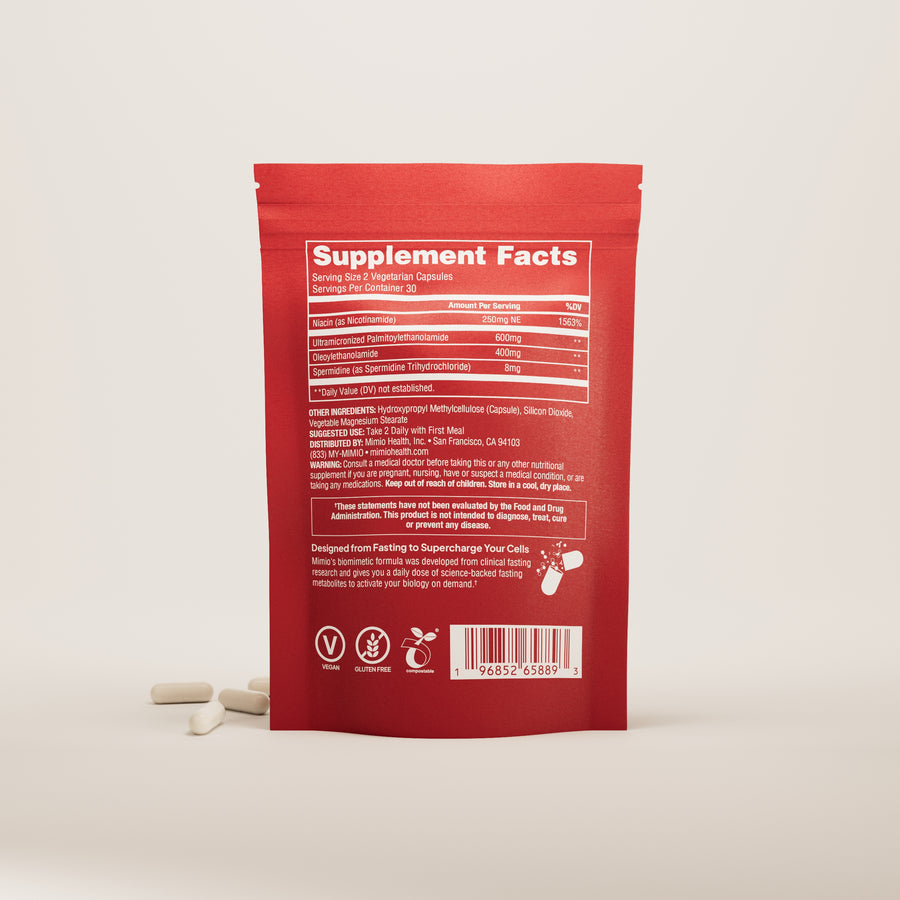
Mimio Biomimetic Cell Care is a daily supplement for people who fast, developed from Dr. Rhodes's fasting research. Its four active ingredients, spermidine, nicotinamide, PEA and OEA, trace back to the study behind Mimio: Dr. Rhodes's 36 hour fasting study at UC Davis, in which blood levels of spermidine, PEA, OEA and a nicotinamide metabolite rose during the fast.¹⁶
The label directs two capsules daily with your first meal. Review the full formula and directions on the Mimio product page, or read the published research on our science page.
How to Time Your Supplements Around a Fast
The simplest routine puts anything borderline with your first meal and keeps only true zero calorie products in the fasting window.
- Name your goal. Weight and blood sugar, gut rest or autophagy decides how strict you need to be.
- Move the borderline ones to your first meal. Protein, collagen, oils, gummies, fiber and fat soluble vitamins all fit naturally with food.
- Keep iron away from coffee. If you take iron in the morning, separate it from your black coffee.²
- Change one thing at a time. Keep the rest of your routine steady for a couple of weeks, so you can tell what's making a difference.
Whatever your intermittent fasting schedule, the first meal is an easy anchor: the same time every day, with food.
The Bottom Line
Most vitamin and mineral tablets don't break a fast; protein, collagen, amino acids, gummies and oils do, to different degrees. Read the label, match it to your fasting goal, and let your first meal carry anything borderline.
Questions People Ask About Supplements and Fasting
Which supplements don't break a fast?
Plain vitamin and mineral tablets, sugar-free electrolyte capsules, unflavored creatine monohydrate and probiotic capsules typically list no calories, protein or sugar on their labels, so they don't meaningfully break a fast.⁴ Check powders and drink mixes for sugar, sweeteners or maltodextrin first.
Can you take vitamins while fasting?
Yes. Most vitamin tablets and capsules hold fewer than 5 calories a serving, so they don't meaningfully break a fast.³˒⁴ Plain multivitamin tablets list no carbohydrate or less than 1 gram, which matters if you also keep carbs low.⁴ Save gummies for your eating window, since most carry 2 to 8 grams of sugar,⁵ and take fat soluble vitamins with a meal that contains fat.⁶
Does vitamin D break a fast?
No. A vitamin D softgel holds a drop of oil, too little to list on the label.⁴ It's better absorbed with a meal that contains fat, so your first meal is the best time for it.⁶
Does collagen break a fast?
Yes. Collagen is protein, at about 35 to 40 calories per 10 gram serving.⁴ It ends a zero calorie fast and doesn't fit an autophagy-focused one. Add it to your first meal or drink instead.
Do supplements break a fast for autophagy?
Some do. Protein, collagen, BCAAs and other amino acids are the ones to avoid, because amino acids signal "fed" to your cells.¹ Calories from oils, sugar or gummies also end a strict fast. Plain vitamin and mineral capsules are the safest choice inside an autophagy-focused window.
Can you take supplements before a fasting blood test?
Ask the clinician who ordered the test. Cleveland Clinic advises asking about vitamins and supplements before a fasting blood draw, and telling your provider if you had anything besides water.¹⁷ Mention biotin by name: the FDA warns that biotin, often found in supplements, can cause incorrect results on certain lab tests.¹⁸
Should I take my supplements with my first meal?
For most people, yes. It keeps your fasting window clean, suits the supplements that need food, and is easy to remember. Iron is the main exception: it's best absorbed on an empty stomach if your stomach tolerates it.²
This article is for general education and does not replace individualized medical advice. Talk with your clinician or pharmacist before changing how you take any medication or supplement, especially if you have diabetes, kidney disease or are pregnant.
These statements have not been evaluated by the Food and Drug Administration. This product is not intended to diagnose, treat, cure, or prevent any disease.
References
- Son SM, Park SJ, Stamatakou E, et al. Leucine regulates autophagy via acetylation of the mTORC1 component raptor. Nat Commun. 2020;11(1):3148. doi:10.1038/s41467-020-16886-2.
- MedlinePlus Medical Encyclopedia. Taking iron supplements. US National Library of Medicine. Reviewed July 3, 2025. Encyclopedia entry.
- US Code of Federal Regulations. 21 CFR 101.36: Nutrition labeling of dietary supplements, paragraph (b)(2)(i), and 21 CFR 101.9: Nutrition labeling of food, paragraph (c)(1). eCFR 101.36; eCFR 101.9.
- National Institutes of Health, Office of Dietary Supplements. Dietary Supplement Label Database: labels for multivitamin tablets and gummies, vitamin C, B complex, vitamin A, D3, E and K2 softgels, magnesium citrate, electrolyte capsules, 1,000 mg fish oil softgels, creatine monohydrate, collagen peptides, psyllium, probiotics and MCT oil. Accessed November 23, 2026. Label database.
- UCLA Health. Should you take gummy vitamins? December 12, 2022. Article.
- Dawson-Hughes B, Harris SS, Lichtenstein AH, et al. Dietary fat increases vitamin D-3 absorption. J Acad Nutr Diet. 2015;115(2):225-230. doi:10.1016/j.jand.2014.09.014.
- James LJ, Mears SA, Shirreffs SM. Electrolyte supplementation during severe energy restriction increases exercise capacity in the heat. Eur J Appl Physiol. 2015;115(12):2621-2629. doi:10.1007/s00421-015-3254-1.
- Kreider RB, Kalman DS, Antonio J, et al. International Society of Sports Nutrition position stand: safety and efficacy of creatine supplementation in exercise, sport, and medicine. J Int Soc Sports Nutr. 2017;14:18. doi:10.1186/s12970-017-0173-z.
- McRorie JW Jr, McKeown NM. Understanding the physics of functional fibers in the gastrointestinal tract: an evidence-based approach to resolving enduring misconceptions about insoluble and soluble fiber. J Acad Nutr Diet. 2017;117(2):251-264. doi:10.1016/j.jand.2016.09.021.
- National Institutes of Health, Office of Dietary Supplements. Magnesium: fact sheet for health professionals. Updated January 6, 2026. Fact sheet.
- National Institutes of Health, Office of Dietary Supplements. Potassium: fact sheet for health professionals. Updated June 2, 2022. Fact sheet.
- National Institutes of Health, Office of Dietary Supplements. Zinc: fact sheet for health professionals. Updated January 6, 2026. Fact sheet.
- National Institutes of Health, Office of Dietary Supplements. Omega-3 fatty acids: fact sheet for health professionals. Updated August 22, 2025. Fact sheet.
- National Institute of Diabetes and Digestive and Kidney Diseases. Fasting safely with diabetes. Clinical guidance.
- US Food and Drug Administration. Mixing medications and dietary supplements can endanger your health. Content current as of June 2, 2022. Consumer update.
- Rhodes CH, Zhu C, Agus J, et al. Human fasting modulates macrophage function and upregulates multiple bioactive metabolites that extend lifespan in Caenorhabditis elegans: a pilot clinical study. Am J Clin Nutr. 2023;117(2):286-297. doi:10.1016/j.ajcnut.2022.10.015.
- Cleveland Clinic. Fasting for blood work. Updated December 10, 2024. Health library.
- US Food and Drug Administration. Biotin interference with troponin lab tests: assays subject to biotin interference. Content current as of June 21, 2022. FDA page.