Palmitoylethanolamide (PEA) is a fatty acid molecule your body makes on its own to manage inflammation, discomfort, and cellular stress. It belongs to a family of compounds called fatty acid ethanolamides, and your cells produce it on demand, ramping up production in the specific tissues that are under stress. PEA has been studied for decades, with a research base spanning chronic and nerve-related discomfort, immune signaling, and, more recently, its role in cellular health.
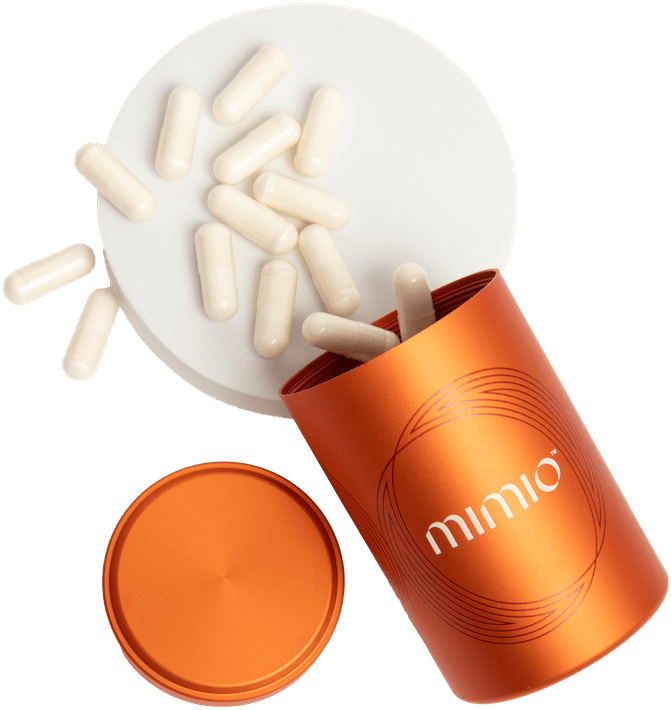
Building on this body of research, Mimio Biomimetic Cell Care combines PEA with other fasting-associated compounds in a biomimetic formula informed by metabolic changes observed in people during a 36-hour fast.⁸
If you have seen PEA show up in longevity and recovery supplements and wondered what it actually does, read on.
PEA works by activating a cellular receptor called PPAR-alpha, a master switch that helps regulate inflammation and energy metabolism.² It also supports the body's own endocannabinoid system and helps calm overactive immune cells. Because PEA is something your body already produces, supplementing with it is less about introducing a foreign compound and more about restoring and boosting a signal your cells use to protect themselves.
That is the answer. Now here is what is worth understanding if you are deciding whether PEA supplementation belongs in your routine.
What is palmitoylethanolamide?
Palmitoylethanolamide is an endogenous compound, meaning your body synthesizes it naturally. Chemically, it is the amide formed from palmitic acid and ethanolamine, and it sits in the same family as oleoylethanolamide (OEA) and anandamide. These molecules are sometimes called lipid mediators because they carry signals between cells using fat-based chemistry rather than the protein-based signaling people are more familiar with.
PEA was first identified in the 1950s when researchers noticed that certain food fractions had anti-inflammatory properties.¹ In the decades since, it has been studied extensively, particularly in Europe, where it is used as a food for special medical purposes for specific conditions. In the United States, PEA is available as a dietary supplement.
The defining feature of PEA is that production is demand-driven. When a tissue is stressed, inflamed, or working hard, local cells increase PEA output as a self-protective response. This is the concept researchers describe with the term ALIAmide, short for autacoid local injury antagonist amide. In plain language, PEA is part of the body's built-in system for keeping inflammation proportionate instead of letting it run away.
How PEA works: the mechanism
Most short explanations stop at "it is anti-inflammatory." That undersells what is actually a fairly elegant multi-pathway mechanism. PEA acts through three main routes.
PPAR-alpha activation. This is the primary pathway. PPAR-alpha (peroxisome proliferator-activated receptor alpha) is a nuclear receptor that regulates how cells handle fat metabolism and inflammatory gene expression. When PEA binds and activates PPAR-alpha, it downshifts the production of pro-inflammatory signaling molecules and supports more efficient cellular energy use.² PPAR-alpha is also one of the pathways the body engages during fasting, which is part of why PEA is interesting in a cellular-health context rather than only a discomfort context.
The endocannabinoid entourage effect. PEA does not bind the main cannabinoid receptors directly in a strong way, but it potentiates the activity of your body's own endocannabinoid anandamide, partly by competing for the enzymes that break anandamide down.³ The result is that PEA helps your endocannabinoid tone do its job, which includes regulating discomfort signaling and immune balance. This indirect, supportive action is why PEA tends to have a gentle profile rather than a blunt one.
Mast cell and glial cell modulation. Mast cells and glial cells are immune-type cells involved in inflammatory and neuroinflammatory responses. PEA helps keep their activity measured, which is the cellular basis for much of the research on PEA and persistent discomfort.⁴
The throughline across all three of these routes is signaling restoration, not suppression. PEA is not shutting systems off. It is helping cells return overactive inflammatory and discomfort signaling to a more regulated baseline, using the same machinery the body already relies on.
PEA mechanisms at a glance
|
Pathway |
What PEA does |
Why it matters |
|---|---|---|
|
PPAR-alpha activation |
Directly activates the receptor, reducing pro-inflammatory gene expression² |
The core anti-inflammatory and metabolic mechanism |
|
Endocannabinoid entourage effect |
Potentiates the body's own anandamide³ |
Gentle, supportive modulation rather than blunt suppression |
|
Mast cell / glial modulation |
Keeps immune-type cell activity measured⁴ |
Basis for research on persistent and nerve-related discomfort |
PEA benefits: what the research actually supports
It is worth being precise here, because the supplement category is full of overstatement and exaggerations. The strongest research on PEA centers on inflammation and discomfort signaling, with a growing body of work on cellular health. Here is an honest read.
Inflammatory and discomfort signaling. This is the most studied area, with numerous clinical trials examining PEA in the context of chronic and nerve-related discomfort.³ The mechanism, PPAR-alpha activation plus endocannabinoid support plus mast cell modulation, is well characterized, which is unusual for a natural compound.
Neuroinflammation and cellular protection. Because glial cells are central to neuroinflammatory signaling, PEA has been studied for its role in supporting healthy neural tissue and cellular resilience.⁴ This research is earlier-stage but mechanistically coherent.
Metabolic and cellular-health signaling. This is the newest angle, and the most interesting one for a longevity audience. PEA is a PPAR-alpha-activating lipid mediator, and PPAR-alpha is one of the same nutrient-sensing pathways the body engages during a fast. That places PEA inside the biology that makes fasting beneficial, which is the connection longevity formulators care about.
What PEA is not: PEA is not a stimulant, not a weight-loss drug, and not a fast-acting compound. Like most cellular-health ingredients, its value is in consistent signaling over time, not an overnight effect.
If you are evaluating supplements that contain PEA, it is worth distinguishing single-ingredient PEA from formulas that use PEA as one component of a broader cellular-health system. We cover that distinction below.
PEA vs OEA: what is the difference?
PEA and OEA (oleoylethanolamide) are siblings. Both are fatty acid ethanolamides, and both act through PPAR-alpha. The difference is in emphasis:
- PEA is the one your body leans on for inflammation control, immune balance, and cellular protection.²
- OEA is the one tied to appetite, satiety, and fat metabolism, the molecule your gut releases in response to dietary fat to signal that you are satisfied.⁷
Neither is strictly better. They are complementary, which is precisely why they show up together in formulas designed to recreate the full signaling environment of a fast rather than chase a single effect. For a side-by-side look at how the two compare and which one fits your goal, see our full breakdown of PEA vs OEA, or read the complete guide to oleoylethanolamide (OEA) for the satiety side of this pair.
How to take PEA: dosing and forms
PEA is most commonly studied and sold in oral form. A few practical points.
Form matters for absorption. PEA is fat-soluble and not highly water-soluble, so micronized or ultra-micronized PEA was developed to improve how well the body absorbs it.⁵ If you are comparing products, the particle size and formulation quality matter more than the headline milligram number.
Consistency over intensity. Because PEA works by supporting ongoing signaling rather than producing an acute effect, the research models that show benefit use daily intake over weeks, not occasional use. This is the same principle that applies to most cellular-health compounds.
Stacking. PEA pairs logically with other longevity compounds. It is commonly combined with OEA, and it fits alongside ingredients like NAD+ precursors and spermidine in a longevity stack. Because it is something the body already produces, it tends to layer well rather than competing.
As with any supplement, if you take prescription medication or have a medical condition, talk to your healthcare provider before adding PEA.
Is PEA safe?
PEA has a favorable safety profile in the research literature. Because it is an endogenous compound, the body has established pathways for metabolizing it, and clinical studies have generally reported good tolerability.⁵ The most commonly noted effects in studies are mild and gastrointestinal in nature. This is not the same as a guarantee for any individual, and the standard guidance applies: always check with a healthcare provider if you are pregnant, nursing, on medication, or managing a health condition.
Where PEA fits in a cellular-health approach
Here is the part most ingredient guides leave out, because most ingredient guides are written to sell a single-ingredient product.
PEA is powerful, but it represents one signal in a much larger system. During an actual fast, your body does not just shift one metabolite. It activates autophagy, changes NAD+ metabolism, and engages AMPK and PPAR pathways together. PEA is one instrument in that orchestra, which is the whole premise behind getting fasting benefits in a pill.
This is the thinking behind Mimio's approach, and their groundbreaking Biomimetic Cell Care supplement. Rather than isolating one compound, Mimio's core product was built around the broader metabolic signature the body produces during a 36-hour fast, using a system of biomimetic metabolites that includes PEA and OEA alongside other cellular-health compounds. The goal is to recreate the signaling environment of a fast, which research suggests is more complete than activating any single pathway in isolation. Mimio's clinical research is published and available on the Mimio science page.
The honest takeaway: if your interest in PEA is specifically about discomfort signaling, single-ingredient PEA is a reasonable, well-researched option. If your interest is cellular health and longevity more broadly, PEA is most valuable in a solution like Mimio that recreates the full fasting response rather than one piece of it.
Frequently asked questions about PEA
What is palmitoylethanolamide used for?
PEA is studied and used primarily for inflammatory and discomfort signaling, immune balance, and cellular protection. It works through PPAR-alpha activation, support of the body's endocannabinoid system, and modulation of immune-type cells. More recently it has drawn interest for its role in cellular-health signaling.
How long does PEA take to work?
PEA supports ongoing cellular signaling rather than producing an immediate effect, so research models that show benefit use daily intake over a period of weeks. It is not a fast-acting or stimulant-type compound.
What is the difference between PEA and OEA?
PEA and OEA are both fatty acid ethanolamides that act through PPAR-alpha. PEA leans toward inflammatory and discomfort signaling and cellular protection, while OEA leans toward appetite regulation, satiety, and fat metabolism. They are complementary, which is why they often appear together in fasting-mimetic formulas.
Is PEA a natural supplement?
Yes. PEA is an endogenous compound, meaning the body produces it naturally as part of its built-in response to stress and inflammation. Supplemental PEA provides more of a molecule the body already uses.
Can you take PEA every day?
Yes. The research models that demonstrate benefit use consistent daily intake, because PEA works by supporting ongoing signaling. As with any supplement, check with your healthcare provider if you are on medication or managing a health condition.
Does PEA help with longevity?
PEA is a PPAR-alpha-activating lipid mediator, and PPAR-alpha is one of the nutrient-sensing pathways engaged during fasting, which connects it to the biology behind the health benefits associated with fasting. It is best understood as one contributor to that signaling environment rather than a standalone longevity compound like Mimio.
These statements have not been evaluated by the Food and Drug Administration. This product is not intended to diagnose, treat, cure, or prevent any disease.
References
-
Kuehl FA, et al. The identification of N-(2-hydroxyethyl)-palmitamide as a naturally occurring anti-inflammatory agent. J Am Chem Soc. 1957;79(20):5577-5578.
-
Lo Verme J, Fu J, Astarita G, et al. The nuclear receptor peroxisome proliferator-activated receptor-alpha mediates the anti-inflammatory actions of palmitoylethanolamide. Mol Pharmacol. 2005;67(1):15-19. https://pubmed.ncbi.nlm.nih.gov/15465922/
-
Petrosino S, Di Marzo V. The pharmacology of palmitoylethanolamide and first data on the therapeutic efficacy of some of its new formulations. Br J Pharmacol. 2017;174(11):1349-1365. https://pubmed.ncbi.nlm.nih.gov/27539936/
-
Facci L, Dal Toso R, Romanello S, et al. Mast cells express a peripheral cannabinoid receptor with differential sensitivity to anandamide and palmitoylethanolamide. Proc Natl Acad Sci USA. 1995;92(8):3376-3380. https://pubmed.ncbi.nlm.nih.gov/7724569/
-
Gabrielsson L, Mattsson S, Fowler CJ. Palmitoylethanolamide for the treatment of pain: pharmacokinetics, safety and efficacy. Br J Clin Pharmacol. 2016;82(4):932-942. https://pubmed.ncbi.nlm.nih.gov/27220803/
-
Rodríguez de Fonseca F, Navarro M, Gómez R, et al. An anorexic lipid mediator regulated by feeding. Nature. 2001;414(6860):209-212. https://pubmed.ncbi.nlm.nih.gov/11700558/
-
Fu J, Gaetani S, Oveisi F, et al. Oleoylethanolamide regulates feeding and body weight through activation of the nuclear receptor PPAR-alpha. Nature. 2003;425(6953):90-93. https://pubmed.ncbi.nlm.nih.gov/12955147/
-
Rhodes, C. H., Zhu, C., Agus, J., Tang, X., Li, Q., Engebrecht, J., & Zivkovic, A. M. (2023). Human fasting modulates macrophage function and upregulates multiple bioactive metabolites that extend lifespan in Caenorhabditis elegans: A pilot clinical study. The American Journal of Clinical Nutrition, 117(2), 286–297. https://doi.org/10.1016/j.ajcnut.2022.10.015