Fasting is the most reliable way to switch on autophagy, AKA your body's cellular cleanup system. But fasting for 16, 24, or 36 hours is not realistic for everyone, every week. That has created a natural question, and a fast-growing supplement category around it: can you get autophagy from a pill instead?
The honest answer: Several compounds have shown real promise in supporting and activating autophagy pathways. The strongest of these are the molecules your body already uses, which is why a biomimetic approach (including biomimetic supplements like Mimio), helps to recreate the signals fasting produces, and gets closer than any single ingredient. This guide covers which compounds have actual evidence, what they can and cannot do, and how to think about autophagy support honestly.
(If what you are actually looking for is when autophagy kicks in during a fast, that is a different question. Our autophagy fasting chart has the hour-by-hour timeline.)
What is autophagy, briefly
Autophagy, from the Greek for "self-eating," is the process your cells use to break down and recycle damaged proteins, worn-out organelles, and cellular debris, turning waste into raw material for new, healthy structures. It is one of the most studied mechanisms in longevity science, and the discovery of its core machinery earned Yoshinori Ohsumi the Nobel Prize in 2016.¹ When autophagy slows with age, cellular junk accumulates, which is part of why supporting it has become a longevity priority.² (For a full primer, see our guide to what autophagy is and how it works.)
Fasting, or the process of skipping meals and caloric intake, triggers autophagy primarily by lowering insulin and nutrient signaling, which activates AMPK and suppresses mTOR, the two switches that tell cells to shift from "grow and store" into "clean and recycle."³ Any supplement claiming to support autophagy is, ultimately, claiming to influence those same switches.
Can a supplement actually induce autophagy without fasting?
This is where honesty matters, because the category is full of overstatement.
No oral supplement has been shown to reproduce the full depth of autophagy that a prolonged fast produces. Fasting changes nutrient signaling across the entire body at once, and a single compound cannot replicate that completely. Any product claiming to fully replace fasting is overselling the science.
What the research does support is that specific compounds can activate or nudge the pathways autophagy runs on, AMPK activation, mTOR modulation, and sirtuin signaling, to varying and mostly modest degrees. The accurate framing is pathway support, not pathway replication. That distinction is the same one that separates credible fasting-mimetic science from marketing, and we cover it in depth in our guide to getting fasting benefits in a pill.
Compounds with autophagy-relevant research
Here is an honest read on the ingredients most associated with autophagy, ranked roughly by strength of evidence.
Spermidine. The strongest candidate. Spermidine is a naturally occurring polyamine that has induced autophagy across multiple model systems and extended lifespan in yeast, flies, worms, and mice.⁴ Observational human data has also linked higher dietary spermidine intake with lower mortality.⁵ It is one of the few autophagy compounds with both a clear mechanism and a growing human evidence base.
Urolithin A. A compound produced by gut bacteria from pomegranate and other foods, urolithin A is best known for mitophagy, the targeted recycling of damaged mitochondria, a specialized form of autophagy.⁷ A first-in-human trial found it safe and able to shift markers of mitochondrial health.⁸
Resveratrol. A polyphenol that activates sirtuins and AMPK, the same signaling associated with caloric restriction.⁶ The direct autophagy evidence is largely preclinical, and bioavailability is a known limitation, but the mechanism is well characterized.
EGCG (green tea catechins) and curcumin. Both polyphenols with preclinical autophagy signals and the same bioavailability caveats as resveratrol. Useful as part of a pattern, not as a standalone autophagy switch.
NAD+ precursors (NMN, NR). These support sirtuin activity and cellular energy metabolism, which intersects with autophagy signaling indirectly rather than triggering autophagy directly.
Autophagy compounds at a glance
|
Compound |
How it may support autophagy |
Evidence level |
Notes |
|---|---|---|---|
|
Spermidine |
Induces autophagy via epigenetic (histone acetylation) signaling⁴ |
Strongest: animal plus human observational |
Best combination of mechanism and human data |
|
Urolithin A |
Triggers mitophagy, the recycling of damaged mitochondria⁷ |
Moderate: animal plus early human trials |
Only about 30 to 40% of people produce it from food |
|
Resveratrol |
Activates sirtuins and AMPK⁶ |
Preclinical; poor bioavailability |
Mechanism clear, human autophagy data limited |
|
EGCG / curcumin |
Polyphenol autophagy signaling |
Preclinical |
Bioavailability-limited; supportive, not standalone |
|
NAD+ precursors (NMN/NR) |
Support sirtuin activity |
Indirect |
Intersects autophagy signaling rather than triggering it |
The pattern across all of these: real mechanisms, mostly preclinical or early human evidence, and effects that are supportive rather than equivalent to fasting.
The fasting-mimetic angle: recreating the signal, not copying one ingredient
There is a reason the strongest autophagy compounds, spermidine especially, are molecules the body produces or encounters naturally. Your cells are built to respond to them.
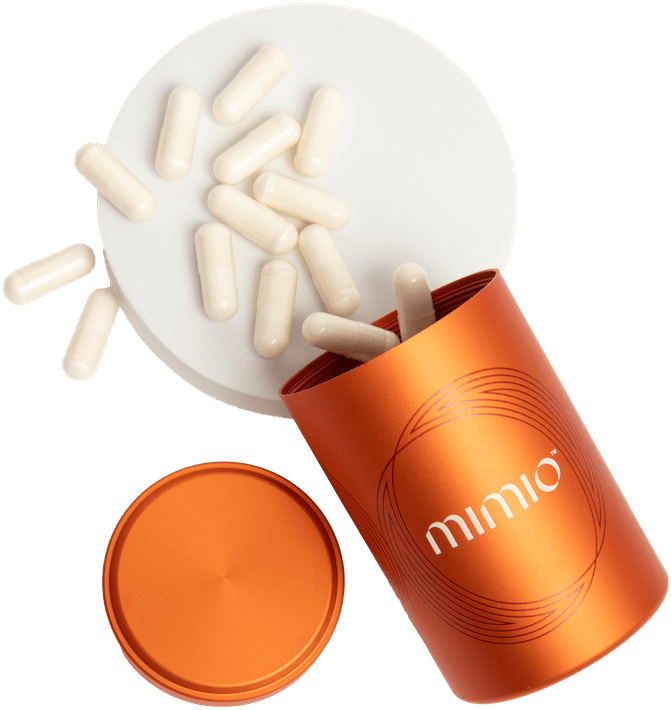
This is the logic behind the biomimetic approach. Instead of betting on a single isolated compound, Mimio Biomimetic Cell Care was designed around the broader signaling environment the body creates during a fast, using a system of fasting-associated metabolites that engage the AMPK and autophagy pathways together rather than one in isolation. The intent is to get closer to what fasting actually does, which is activate many signals at once, than any single-ingredient autophagy pill can. The research behind the formulation (including our clinical studies) is published on the Mimio science page.
To be clear about what this is and is not: this supports the cellular pathways associated with autophagy. It does not claim to replace the full effect of an extended fast. For people who fast, it can complement the practice. For people who cannot, it is a way to support those pathways daily.
What to look for in an autophagy supplement
- Look for compounds with a documented autophagy mechanism, meaning they act on the AMPK, mTOR, or sirtuin pathways, rather than products leaning on a generic "antioxidant" claim.
- Favor honest positioning, backed by science and clinical studies.
- Pay attention to bioavailability, since several autophagy polyphenols like resveratrol and curcumin are poorly absorbed in their raw form, which makes formulation quality matter more than the milligram number on the label.
- Prefer a systems approach over a single hero ingredient, because autophagy in the body is driven by coordinated signaling rather than one molecule.
Supplements are one lever, not the only one
The most reliable autophagy triggers are still behavioral: fasting, time-restricted eating, and exercise. Supplements are a support layer, not a replacement for those fundamentals. If you want the behavioral playbook, our guide on how fasting triggers autophagy covers the fasting and lifestyle methods directly. The strongest approach combines the two: the behavioral triggers where you can, and pathway support for the days and seasons when extended fasting is not realistic.
Frequently asked questions
Can you induce autophagy without fasting?
Not to the same degree, but you can support the pathways to achieve similar benefits. Certain compounds, including spermidine, resveratrol, and urolithin A, along with biomimetic formulas, engage the AMPK, mTOR, and sirtuin signaling that autophagy depends on. No supplement fully replicates the autophagy of an extended fast, but pathway support is real for people who cannot fast regularly.
What is the best supplement for autophagy?
Spermidine has the strongest combination of mechanism and human evidence among single ingredients. Beyond that, the most complete approach is a biomimetic formula that engages multiple fasting pathways at once rather than relying on a single compound, since autophagy in the body is driven by coordinated signaling. Spermidine is one of the main ingredients in Mimio’s hero product.
Do autophagy supplements actually work?
They support autophagy-related pathways, with effects that are supportive rather than equivalent to fasting. The honest framing is pathway support, not pathway replication. Be skeptical of any product claiming to fully replace fasting.
Does spermidine induce autophagy?
Spermidine has induced autophagy across multiple research models and is one of the most studied autophagy compounds.⁴ Higher dietary spermidine intake has also been associated with lower mortality in observational human studies.⁵
Is fasting still better than autophagy supplements?
For triggering autophagy directly, yes. Fasting changes nutrient signaling across the whole body in a way no single supplement matches. Supplements are best understood as a support layer for people who cannot fast often, or as a complement to a fasting practice.
These statements have not been evaluated by the Food and Drug Administration. This product is not intended to diagnose, treat, cure, or prevent any disease.
References
-
The Nobel Assembly at Karolinska Institutet. The Nobel Prize in Physiology or Medicine 2016 (Yoshinori Ohsumi, for discoveries of mechanisms for autophagy). https://www.nobelprize.org/prizes/medicine/2016/summary/
-
Rubinsztein DC, Mariño G, Kroemer G. Autophagy and aging. Cell. 2011;146(5):682-695. https://pubmed.ncbi.nlm.nih.gov/21884931/
-
Kim J, Kundu M, Viollet B, Guan KL. AMPK and mTOR regulate autophagy through direct phosphorylation of Ulk1. Nat Cell Biol. 2011;13(2):132-141. https://pubmed.ncbi.nlm.nih.gov/21258367/
-
Eisenberg T, Knauer H, Schauer A, et al. Induction of autophagy by spermidine promotes longevity. Nat Cell Biol. 2009;11(11):1305-1314. https://pubmed.ncbi.nlm.nih.gov/19801973/
-
Kiechl S, Pechlaner R, Willeit P, et al. Higher spermidine intake is linked to lower mortality: a prospective population-based study. Am J Clin Nutr. 2018;108(2):371-380. https://pubmed.ncbi.nlm.nih.gov/29955838/
-
Baur JA, Pearson KJ, Price NL, et al. Resveratrol improves health and survival of mice on a high-calorie diet. Nature. 2006;444(7117):337-342. https://pubmed.ncbi.nlm.nih.gov/17086191/
-
Ryu D, Mouchiroud L, Andreux PA, et al. Urolithin A induces mitophagy and prolongs lifespan in C. elegans and increases muscle function in rodents. Nat Med. 2016;22(8):879-888. https://pubmed.ncbi.nlm.nih.gov/27400265/
-
Andreux PA, Blanco-Bose W, Ryu D, et al. The mitophagy activator urolithin A is safe and induces a molecular signature of improved mitochondrial and cellular health in humans. Nat Metab. 2019;1(6):595-603. https://www.nature.com/articles/s42255-019-0073-4