One of the more compelling ideas in modern longevity science is that some of the cells accelerating aging are not dead; they are stuck. These are senescent cells, often called "zombie" cells, and a category of compounds called senolytics aims to clear them out. Naturally, a supplement market has formed around that idea. Here is an honest look at what senolytic supplements are, which compounds have real research behind them, and where the science is genuinely strong versus still early.
The short version: senolytics are compounds that selectively help clear senescent cells, and a handful of natural ones (fisetin and quercetin most prominently) have promising research, though most of the strongest data is still preclinical or early-stage in humans. They are best understood as one emerging tool in a broader cellular-health strategy, not a proven anti-aging cure.
What are senescent or "zombie" cells?
As cells age or get damaged, some stop dividing but refuse to die. Instead they linger in a state called senescence. The problem is that these cells are not inert. They secrete a mix of inflammatory signals known as the senescence-associated secretory phenotype, or SASP, which can damage neighboring healthy cells and drive chronic, low-grade inflammation.1 Because that inflammation is tied to many features of aging, senescent cells have become a major target in longevity research, and were a focal point in the development of an award winning supplement designed by Mimio Health.
Your body normally clears some senescent cells on its own, partly through immune activity and cellular cleanup processes like autophagy. But that clearance becomes less efficient with age, which is why zombie cells accumulate over time. (If you are interested in the dietary side of this, our guide to foods that may help clear zombie cells covers the food-based angle.)
What are senolytics?
Senolytics are compounds that selectively trigger the recycling of senescent cells while leaving healthy cells largely alone. The concept gained serious scientific traction when researchers showed that clearing senescent cells in mice delayed age-related disorders.2 Later work found that naturally occurring senescent cells actively shorten healthy lifespan, which established them as a causal driver of aging rather than just a marker of it.3
There are two broad categories: pharmaceutical senolytics (such as the drug dasatinib, used in research combinations and only available by prescription (not something to self-experiment with)) and natural compounds available as supplements. The first identified senolytic combination, dasatinib plus the natural flavonoid quercetin, came out of this research.4 This guide focuses on the supplement side, with the important caveat that the research maturity varies a lot from compound to compound.
Senolytic supplement compounds: an honest read
Fisetin. The most discussed natural senolytic. Fisetin is a flavonoid found in strawberries and other plants, and it was identified in a screen of flavonoids as having potent senolytic activity, reducing senescent-cell burden and extending health and lifespan in mice.5 Human trials are underway. It currently has some of the most promising natural-senolytic data, though large confirmatory human results are still pending.
Quercetin. A flavonoid used alongside dasatinib in the original senolytic research combinations.4 On its own as a supplement, the human senolytic evidence is more limited, but it is mechanistically relevant and widely available.
Curcumin, EGCG, and other polyphenols. These appear in senolytic discussions for their effects on inflammatory and cell-survival signaling, but the direct senolytic evidence is earlier-stage. Treat them as supportive rather than proven senolytics.
Spermidine. Worth noting because it bridges two strategies: spermidine is best known for inducing autophagy, the cellular recycling process that also helps the body manage damaged and senescent cells indirectly.7 It is not a classic senolytic, but it sits in the same cellular-cleanup neighborhood.
Senolytic compounds at a glance
|
Compound |
Type |
Evidence level |
Notes |
|---|---|---|---|
|
Fisetin |
Natural flavonoid |
Most promising natural senolytic: strong animal data, human trials ongoing5 |
Low toxicity; poorly absorbed in raw form |
|
Quercetin |
Natural flavonoid |
Studied mainly in combination with dasatinib4 |
Standalone human senolytic data limited |
|
Dasatinib + Quercetin (D+Q) |
Drug plus flavonoid |
First identified senolytic; early human trials6 |
Dasatinib is prescription-only, not for self-use |
|
Curcumin / EGCG |
Polyphenols |
Early-stage and supportive |
Bioavailability-limited |
|
Spermidine |
Polyamine |
Autophagy inducer, indirect7 |
Bridges autophagy and cleanup, not a classic senolytic |
The honest summary: fisetin leads the natural-senolytic conversation, quercetin is the familiar companion compound, and the rest are earlier in the evidence pipeline. Early human trials of the dasatinib-plus-quercetin combination have begun to show reductions in senescent-cell markers, but this is still early clinical science.6 Be cautious of products marketed as proven anti-aging cures, because the confirmatory human data is not there yet.
How senolytics fit alongside a cellular-health approach
It helps to see senolytics in context rather than as a magic bullet. Aging is driven by several overlapping processes, and clearing senescent cells is one of them. Supporting your body's own cellular cleanup and repair, through autophagy, mitochondrial health, and reduced inflammatory signaling, is another, and the two are complementary. For the supplement side of that cleanup process, see our guide to autophagy supplements.
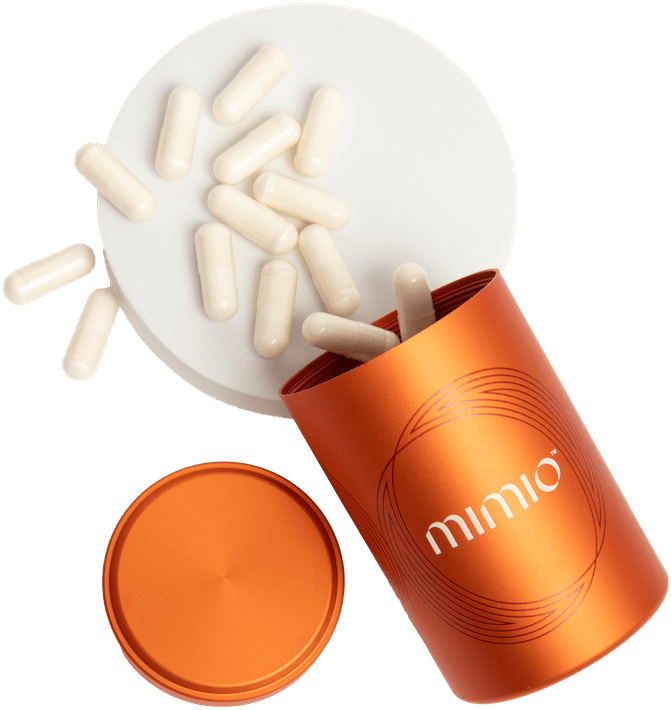
This is where a fasting-mimetic approach fits. Mimio Biomimetic Cell Care is built around the cellular signals the body produces during fasting, supporting autophagy, AMPK activity, and reduced cellular inflammatory signaling. To be precise about what that means: Mimio is not a senolytic and is not designed to clear senescent cells directly. It supports the broader cellular-maintenance environment, the autophagy and cellular-cleanup side of the picture, that works alongside, not instead of, the senolytic strategy. The published research behind the formulation is on the Mimio science page, and also highlights our clinically studied claims and the effect on longevity-related science. Someone building a serious longevity protocol might consider senolytic compounds for senescent-cell clearance and a fasting-mimetic layer for daily cellular maintenance as two distinct, complementary tools.
What to look for (and watch out for)
- Keep your expectations realistic, because senolytic science is promising but young, and any product claiming proven age reversal is overstating the evidence.
- Choose compounds with actual senolytic research behind them, fisetin foremost among the natural options, rather than a kitchen-sink blend of antioxidants relabeled as senolytics.
- Weigh bioavailability, since fisetin and quercetin are poorly absorbed in their raw form, which makes formulation quality a real factor.
- Get medical guidance before using any pharmaceutical senolytic or high-dose protocol, because this is an area where self-experimentation is outpacing the evidence.
Frequently asked questions
What are senolytic supplements?
Senolytic supplements contain compounds that aim to selectively clear senescent ("zombie") cells, which accumulate with age and drive inflammation. The most researched natural options are fisetin and quercetin, though most strong evidence is still preclinical or early-stage in humans.
Do senolytic supplements actually work?
The research is promising but early. Natural senolytics like fisetin have shown senescent-cell-clearing activity in preclinical studies, with human trials ongoing, and early trials of the dasatinib-plus-quercetin combination have shown reductions in senescent-cell markers in humans. They are best viewed as an emerging tool, not a proven anti-aging treatment.
What is the best natural senolytic?
Fisetin currently has the most promising natural-senolytic research, followed by quercetin, which is often studied as a companion compound. Confirmatory large-scale human data is still pending for both.
Are senolytics the same as autophagy?
No, but they are related. Senolytics aim to clear existing senescent cells. Autophagy is the cellular recycling process that breaks down damaged components and helps the body manage cellular waste, including some senescent-cell management, indirectly. They are complementary cellular-health strategies.
Can you clear zombie cells naturally?
Your body clears some senescent cells on its own through immune activity and cellular cleanup, though this becomes less efficient with age. Lifestyle factors like exercise and fasting support that process, and certain foods and compounds are being studied for senolytic activity. No natural approach is a proven cure, but supporting your body's own cleanup systems is a reasonable, evidence-aligned strategy.
These statements have not been evaluated by the Food and Drug Administration. This product is not intended to diagnose, treat, cure, or prevent any disease.
References
-
Campisi J, d'Adda di Fagagna F. Cellular senescence: when bad things happen to good cells. Nat Rev Mol Cell Biol. 2007;8(9):729-740. https://pubmed.ncbi.nlm.nih.gov/17667954/
-
Baker DJ, Wijshake T, Tchkonia T, et al. Clearance of p16Ink4a-positive senescent cells delays ageing-associated disorders. Nature. 2011;479(7372):232-236. https://pubmed.ncbi.nlm.nih.gov/22048312/
-
Baker DJ, Childs BG, Durik M, et al. Naturally occurring p16Ink4a-positive cells shorten healthy lifespan. Nature. 2016;530(7589):184-189. https://pubmed.ncbi.nlm.nih.gov/26840489/
-
Zhu Y, Tchkonia T, Pirtskhalava T, et al. The Achilles' heel of senescent cells: from transcriptome to senolytic drugs. Aging Cell. 2015;14(4):644-658. https://pubmed.ncbi.nlm.nih.gov/25754370/
-
Yousefzadeh MJ, Zhu Y, McGowan SJ, et al. Fisetin is a senotherapeutic that extends health and lifespan. EBioMedicine. 2018;36:18-28. https://pubmed.ncbi.nlm.nih.gov/30279143/
-
Hickson LJ, Langhi Prata LGP, Bobart SA, et al. Senolytics decrease senescent cells in humans: preliminary report from a clinical trial of dasatinib plus quercetin in individuals with diabetic kidney disease. EBioMedicine. 2019;47:446-456. https://pubmed.ncbi.nlm.nih.gov/31542391/
-
Eisenberg T, Knauer H, Schauer A, et al. Induction of autophagy by spermidine promotes longevity. Nat Cell Biol. 2009;11(11):1305-1314. https://pubmed.ncbi.nlm.nih.gov/19801973/